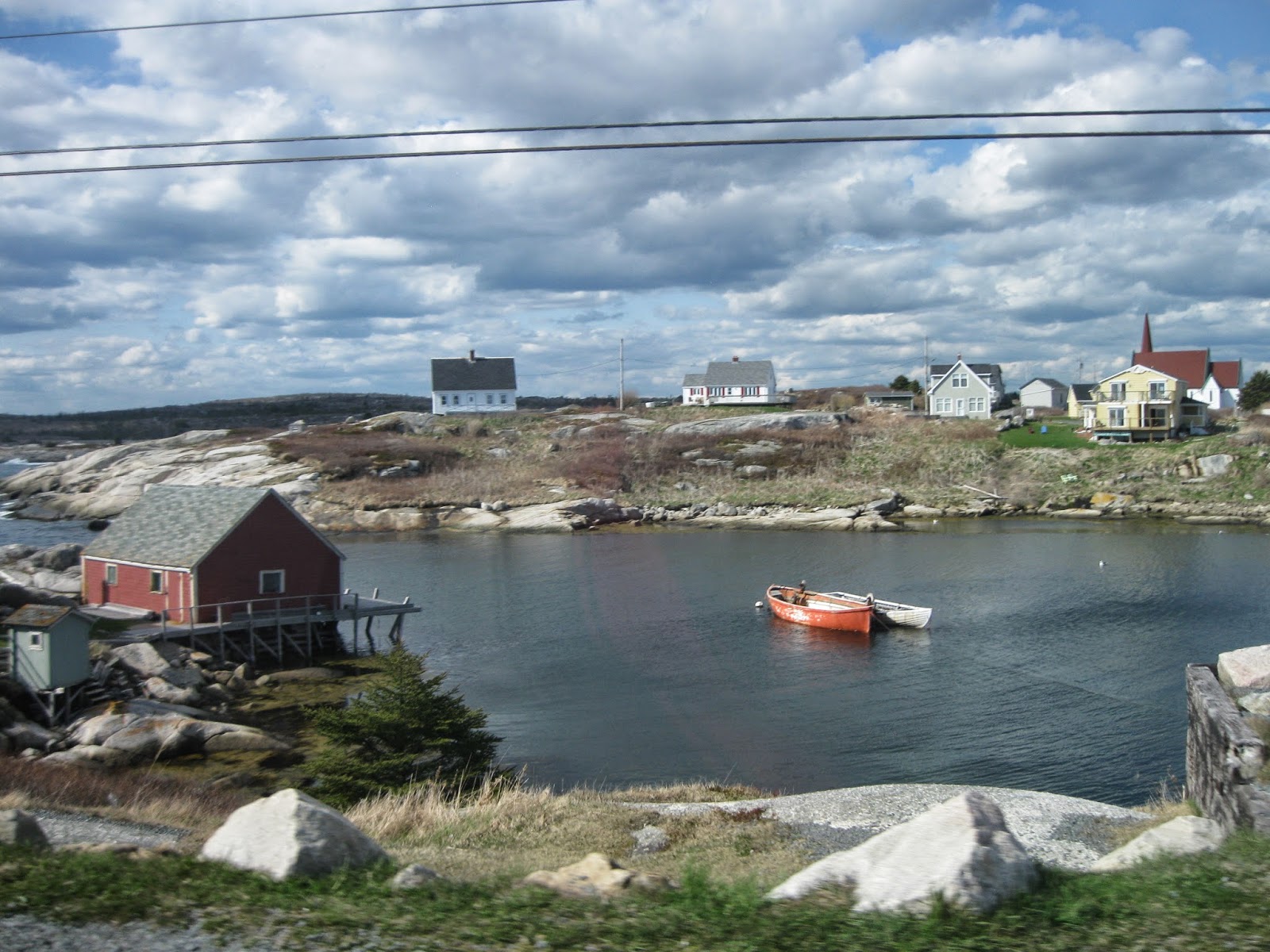
Halifax was founded in 1749 as a counter to the French owned Louisbourg. It is the second largest natural harbour in the world. These are just two of the facts Owen and I discovered as we toured along the waterfront and area.
Our first stop was St. Paul's Anglican Church. As mentioned in the previous post, this is the oldest existing Protestant place of worship in Canada. It is also the burial place of Charles Inglis, the first bishop of Nova Scotia. He is also the first bishop appointed to a British Colony. The church doors opened on September 2,1750 after being founded by royal proclamation in 1749.
The church was full of history. They kindly supplied a walking tour pamphlet to help us as we walked around the building. They have two baptismal fonts. The smaller one is actually from a century or more before St. Paul's was founded.
If you look at the bottom left of the second picture you will see a plaque in the floor. This marks the burial place of Charles Inglis. This has special meaning for me. Not only is he the first bishop but I had to present a seminar on him when I was in seminary. Charles Inglis was consecrated in 1787. He made St. Paul's his cathedral. It remained as the cathedral for the diocese until 1865.
The pews were box pews. At the back in the display cases you could see the receipt for the rental of a pew. The front pew on the left side of the centre aisle was the royal pew. I knew it was set apart as soon as I saw the arm rests. I walked around to the side of it and saw that it was roped off. The general public cannot sit in this pew. As a side note of interest, the gentleman who spoke to us told us that things were being prepared for the royal visit next week. So I assume the pew will be in use then.
Our visit here tied in with our later visit to the Maritime Museum. The tie in is the Halifax explosion on December 6, 1917. We were able to join in a tour about the explosion just as we started wandering around the museum. The tie-in with St. Paul's is that the vestry of St. Paul's was used as an emergency hospital. The church was also used to place numerous bodied which were laid in tiers around the walls.
While at the church I discovered some brochures on something called the Old Burying Grounds. I knew from a previous visit that this area of Halifax has a number of cemeteries. Using the map application on my phone we headed over to this particular cemetery. The first grave here was dug the day after the settlers arrived - June 21, 1749. Over 12,000 people were buried here until 1844. Of those around 1200 headstones remain today. The deeds to the cemetery were granted to St. Paul's vestry in 1793.
In 1860 the city's first public monument was erected. The Welsford-Parker Monument was dedicated to two soldiers who fought in the Crimean War. They died on September 8, 1855.
We didn't stay overly long in the cemetery as it had started to rain. We decided to tour someplace indoors. Off we headed to the Maritime Museum of the Atlantic. Thank goodness for map applications on cell phones. Here we learned about the Halifax Explosion. The tour guide also told us of individuals and their fates due to the explosion. The displays told of us of others. Around 2000 people were killed and another 9000 wounded. Things were made worse by a horrendous snow storm the next day that hampered efforts and made things more difficult for those who lost their homes in the explosion.
We wandered through the small craft gallery which housed actual boats.
There were also displays and historical notes on things such as the History of the Canadian Navy and the Titanic. There were many models of various ships. The time and patience needed to craft these was evident in the models on display. Having raised the children with the TV show, Theodore Tugboat, another display caught my attention. I hadn't realized that the show used the Halifax waterfront as its model for Theodore's home.
We were getting quite hungry so we left the museum and headed out looking for a place to eat. We happened on a pub named The Split Crow. We liked the menu board outside so we headed in. We didn't realize that we were in a place rich with history until we read the menu. The Split Crow started out as the Spread Eagle in 1749. It quickly became known as the Split Crow. The menu told us it was "a second home for sailors, mariners, and travelers. They were given comfortable lodgings, food and generous mugs of grog. In the tradition of the day music was played, ladies entertained, politics were discussed and, inevitably, fights broke out. One of these fights resulted in the first ever murder charge in Nova Scotia."
Just a couple of more pictures. I was in seventh heaven when I discovered a real purple house. I had seen colours Owen tried to convince me were purple but this one was very definitely purple.
The last picture is the naval yards we passed on our way home.
We are renting a car tomorrow and heading out to Cape Breton and Louisbourg. We plan on staying in B and B. We will see what adventure lies our way.
Love and Prayers,
Amie
Monday, May 12, 2014
Mother's Day
We started the day right - getting everyone out of bed to go to church in downtown Halifax. I had thought that we could go to St. Paul's because of its history - the oldest Protestant church in Canada at 260 years old. The later service was Matins and I knew that wouldn't feed Owen's soul. So we decided to go to the Cathedral Church of All Saints. This is a newer building built in 1910 or so. They advertized that they were having a choral mass. We got there and discovered that it was Marbeke. I haven't sung a plainsong mass in years. I wasn't sure how Owen's family would respond to such an old service but they enjoyed it.
This was a very welcoming church. I really think the Maritimers have ministry of hospitality. We found the people at All Soul's chapel in Charlottetown very welcoming. I had put it down to the fact that with Rob we doubled the congregation that day. Even at All Saints - a cathedral - we were made to feel so welcome. At the beginning of the service one of the Sunday School teachers came and introduced himself and invited Owen's niece to join them (reminds me of a few Sundays back when the children of St. Thomas came to their teacher to tell her that there was a new kid in church and he was made to feel welcome in so many ways - including the children choosing him to be the one to extinguished a lenten candle). after the service Owen was approached and welcomed by a woman. When she found that we were visiting and interested in learning more about the church she called her husband over. Her husband is the son of a former dean and takes great pride in the cathedral.
In all honesty, the outside of the church is not very attractive. The inside could appear rather cold due to its size and ornateness. But the congregation has done a very good job of making it warm and welcoming. During Hurricane Juan windows were broken and water got into the cathedral warping the hardwood flooring. The congregation replaced the wood with tile - which had been the original idea for flooring when the cathedral had been built. Instead of pews they had padded chairs with kneelers on the back. There were book holders on the sides. This allowed for flexibility in the nave. We saw how this worked around their various services. The back rows were turned toward the baptismal font instead of the front altars. There was a third altar set up just in front of the font. The nine o'clock service used this space. The ten thirty service used the traditional space. These chairs also allowed for rearrangement for concerts and other functions. Even the pipe organ console could be moved out and placed where the lower altar sits.
There was a corner, visible in the second picture, for a commemoration of the Battle of the Atlantic. A congregation member had done a number of pictures of the battle (and other pictures throughout the cathedral). There was some controversy around the pictures with some people feeling they were to real with bodies and such. Just in front of this commemoration is the columbarium. Our guide explained how the cathedral could support expansion of this when the present space became full.
The wood carvings were amazing. So much of the wood was carved with intricate detail. There were chairs for the various canons as well as the bishop's chair and the one for the chancellor. A few years ago the woman had a needle work project. They did seat and kneeling cushions for each chair. Each chair represents a different regions so each cushion has its own crest or symbols.
For the first time I was able to see an Easter garden. This was something I read about briefly when putting together my Easter Day services (I came across a blessing for an Easter garden in Times and Seasons out of the Church of England). I was quite interested in this as I had thought it would make a good project with the Sunday School children. I will research this a little more when I get home.
We left the church and headed out for Mother's Day brunch - us and everyone else in Halifax. We were able to get a table at a fancy cafe a short distance from the cathedral. The food was definitely not plain and was excellent. Owen leaned over to me and suggested a price for the buffet. The two men argued over who was to pay the bill. Owen won. He took one glance at the bill and told Bill that they could go fifty-fifty. The cost was double what he had expected.
Later in the afternoon we decided to head out to Peggy's Cove. I had been there back in '72 with my parents but Owen had missed it in his '93 trip. Off we headed through little coastal towns and down windy roads. We got to Peggy's Cove. The wind was not too bad but it was still enough to satisfy my soul.
The sea gull in the last picture was quite well behaved. We checked the roof of the car (not ours) and he had left no reminders of his presence. We just thought it was neat to see a sea gull on top of a car and took the picture.
The power of the sea is amazing. I feel an affinity with the sea. Marie means salty water or salty tears. Its origins are with the sea goddess - Mari. I love sitting on the rocks with the wind blowing through my hair (this does not do wonders for the hair do) and watch the waves crash on the rocks. I also love the challenge of climbing on the rocks to get from one point to the other. I am in my elements here on the rocky coast. Still the quiet sun on a prairie meadow also speaks to my soul calming it and lulling me into peace. The harsh wind and rocky shores of the coast speak to me in a different way - the awesome and untamed wonder of God's creation.
We took a few moments to stop off at one of the memorials for Swiss Air Flight 111 on September 2, 1998. I sat quietly here thinking of the people on the plane and of the rescuers and spectators helpless to bring life to such a death scene. I can only imagine how people felt as they stood on that spot looking out to the sea knowing there was little they could do other than bring in what ever the ocean chose to give up.
Today we are headed to the wharf in Halifax.
Love and Prayers,
Amie
Friday, May 09, 2014
Prince Edward Island
We are now in Nova Scotia. We took a shuttle bus from Charlottetown right to Tammy's front door. We crossed the Confederation Bridge - 13 km long across the ocean. Not my idea of fun but there was very little wind so I was actually quite relaxed. The driver and a couple of passengers were quite chatty and supplied us with information and stories for most of the four hour trip. It is always wonderful to hear the local stories.

Yesterday was a full day of sight seeing and traveling. Owen and Rob were done with the convention - huge banquet on Wednesday night - and so we set off looking for adventure. PEI is just gearing up for tourist season so things are beginning to open.
We heard a cruise ship was docking so we headed down to the harbour to see it. While there Rob kindly took a picture of us for a friend who wanted it for her holiday album.
If you think I look cold - I was. The wind off the ocean is quite chilly. This is because the ocean around PEI (unlike around Nova Scotia) freezes in the winter. The ice has just melted so the water is quite cold. The wind picks up this cold as it blows across the water and kindly leaves it with me. Even Owen had to wear a jacket.
We started wandering back to the hotel. As mentioned our hotel is an old one. Lots of character. But then I found so many old character buildings on the island. It became a joke between Owen and me that I wanted to find a real fixer-upper and retire there with lots of work to keep Owen busy. Every old house we looked at became a house with potential. Here is a picture of our hotel.
On our way back we stopped off at Province house - the birthplace of Confederation. We watched a 17 minute video about the events of 1864 leading to 1867. It was quite interesting - giving details we hadn't learned in our social studies class in high school.


The first picture is Province House. The second picture is the table where ideas for confederation were discussed. Speakers were eloquent and passionate. The whole process took place around a week of relationship building (Hmmm. I wonder who consistently preaches about the importance of relationship building in moving forward as a church.) The third picture is the speaker's chair and clerks' table for the legislature. It amazed me how small the room actually was compared to the one in Saskatchewan. It looked quite cozy to me.
Our next stop was St. Dunstan's Roman Catholic Basilica. I took a bit of time here to light a candle for my two wonderful parishes.


Our next stop was All Soul's chapel at St. Peter's Anglican Cathedral for Matins. We were a little late but snuck in anyway.
The wood looks black but it is actually red mahogany. You can see the red in the arches. The black comes from when they used coal heat. The coal dust produced turned the red to the beautiful (I think) black colour it is now. The red in the arches is from an attempt to clean the coal dust off the wood. The project proved to be greater than anticipated and so was abandoned.
All Soul's was built after the death of a beloved rector. Two parishioners decided to build a chapel in his memory. It was then decided that it be named in memory of all who had died. The one side of the building has stain glass windows. All along the walls are pictures.

The first picture is in memory of two young children that died. The children are the ones on Jesus' knee. The second picture is the Holy Family. The models for this were the artist's own family. The older man to the side is the architect of the chapel.
We had a wonderful visit with a parishioner and the lay reader. Normally Mass would have followed Matins but the priest was sick and a lay reader filled in for the first service. We were also able to see the cathedral. We heard many stories about various things in the church as well as about current projects.


What amazed me is that this church is kept unlocked during the day. About 15 years ago there was an incident when there was some vandalism done. A fair sized man with a mental illness came into the chapel. He took the altar cross and tried to dig out a big stone at the top of one of the pillars. The cross was found on the floor bent out of shape. The congregation was able to send it to a church supply company and have it repaired. Two years later the same thing happened again. The church supply company told the congregation there was nothing they could do to repair the cross. Fortunately, they found someone more local who was able to give it a try. The cross was repaired. There was nothing that could be done about the scars at the back of the cross. The woman I was talking with thought that was quite appropriate. The church was kept locked after that. Gradually the congregation became comfortable leaving the door unlocked during tourist season again.
Another story was about the stain glass windows. Lead has a life span of about 100 years. A few years back the windows started to bow out. The congregation priced out how much it would cost to have them redone. To their dismay it was about $25,000 just to crate them for the shipping. There was no way they could afford that. They found someone more local who was willing to camp over two summers and work on the windows. The cost came to about $32,000. The money to pay for these windows was raised by picking bottles. There may have been something about fudge as well. The woman who was telling me the story also spoke about making fudge every Saturday and taking it to the staff at local businesses. Each business would be visited about once every six weeks.
One other story about windows. They cleaned the windows in the chapel a number years ago. Once again the culprit was the coal heating. They discovered a serpent in one of the windows. A visiting bishop remarked "Scratch the surface of anything and there will be the devil underneath."
It was proof of a small world when I discovered that one of the woman on the shuttle to Nova Scotia also went to St. Peter's.
Rob wanted to go for lunch at Georgetown about an hour away. We headed back to the hotel to get the car. Georgetown is about an hour out. The speed limit is 90 km/hr but we often had to go slower through frequent settled areas. You don't go far between places. We also found that the 90 was taken by drivers as a suggested speed. Even doing 110 we were passed frequently.
Georgetown tells part of the story of modern PEI. I found it interesting during the video at Province House that at the time of Confederation that PEI was one of the wealthier provinces. That isn't the case now. There are some wonderful houses but more frequently the houses we saw were in need of some TLC - giving Owen and me lots of resources for our game of picking which fixer-upper. Georgetown was a prime example of this. There were some beautifully restored or upkept houses and a fair number of very "tired" ones. One thing we noted though was how clean and tidy all the yards were. There was very little garbage laying around and all the yards were raked.
From Georgetown we headed back to Charlottetown so we could head out to Green Gables. On our way to Cavendish we passed through North Rustico. Our entertainer the night before had spoken of this place as his home town. He also tried to convince us that the Farmer's Bank there was actually the first Credit Union in Canada. Owen is not sure about this as he has always understood the first Credit Union to have been in Quebec. He was quite interested in seeing the building that had held the Farmer's Bank.

Owen was also fascinated by all the churches on the island and would take pictures each time we passed by one. This next picture was also taken at North Rustico. It is the oldest Catholic church on the island built in 1838.

Next stop was Green Gables. It was just in the process of being opened. Actually it was great being there without all the other tourists. We basically had the place to ourselves. We could experience it as the place it would have been when Anne of Green Gables was first written.


The first picture is the back of Green Gables. The second is the parlour. The third was taken for my mom who loved crocuses. The fourth is taken from the Haunted Woods. And the last is taken on Lover's Lane.
By now we were getting hungry so we headed back to Charlottetown for the guys to have their lobster feast. The one they had on Tuesday night only whet their appetite for more. We had heard wonderful things about a particular restaurant on the harbour front. It definitely lived up to its reputation. And the waiter was absolutely awesome especially because he made sure my coffee cup was never empty. He was wonderful to talk to - so full of tidbits of information. I have always found Maritimers the most hospitable of people. With one exception (The sit down lunch where the servers absolutely refused to give me coffee until desert time - never come between me and my coffee) I found they nearly bent over backwards to make sure we got everything we would ever need.
Love and Prayers,
Amie
Yesterday was a full day of sight seeing and traveling. Owen and Rob were done with the convention - huge banquet on Wednesday night - and so we set off looking for adventure. PEI is just gearing up for tourist season so things are beginning to open.
We heard a cruise ship was docking so we headed down to the harbour to see it. While there Rob kindly took a picture of us for a friend who wanted it for her holiday album.
If you think I look cold - I was. The wind off the ocean is quite chilly. This is because the ocean around PEI (unlike around Nova Scotia) freezes in the winter. The ice has just melted so the water is quite cold. The wind picks up this cold as it blows across the water and kindly leaves it with me. Even Owen had to wear a jacket.
We started wandering back to the hotel. As mentioned our hotel is an old one. Lots of character. But then I found so many old character buildings on the island. It became a joke between Owen and me that I wanted to find a real fixer-upper and retire there with lots of work to keep Owen busy. Every old house we looked at became a house with potential. Here is a picture of our hotel.
On our way back we stopped off at Province house - the birthplace of Confederation. We watched a 17 minute video about the events of 1864 leading to 1867. It was quite interesting - giving details we hadn't learned in our social studies class in high school.
The first picture is Province House. The second picture is the table where ideas for confederation were discussed. Speakers were eloquent and passionate. The whole process took place around a week of relationship building (Hmmm. I wonder who consistently preaches about the importance of relationship building in moving forward as a church.) The third picture is the speaker's chair and clerks' table for the legislature. It amazed me how small the room actually was compared to the one in Saskatchewan. It looked quite cozy to me.
Our next stop was St. Dunstan's Roman Catholic Basilica. I took a bit of time here to light a candle for my two wonderful parishes.
Our next stop was All Soul's chapel at St. Peter's Anglican Cathedral for Matins. We were a little late but snuck in anyway.
The wood looks black but it is actually red mahogany. You can see the red in the arches. The black comes from when they used coal heat. The coal dust produced turned the red to the beautiful (I think) black colour it is now. The red in the arches is from an attempt to clean the coal dust off the wood. The project proved to be greater than anticipated and so was abandoned.
All Soul's was built after the death of a beloved rector. Two parishioners decided to build a chapel in his memory. It was then decided that it be named in memory of all who had died. The one side of the building has stain glass windows. All along the walls are pictures.
The first picture is in memory of two young children that died. The children are the ones on Jesus' knee. The second picture is the Holy Family. The models for this were the artist's own family. The older man to the side is the architect of the chapel.
We had a wonderful visit with a parishioner and the lay reader. Normally Mass would have followed Matins but the priest was sick and a lay reader filled in for the first service. We were also able to see the cathedral. We heard many stories about various things in the church as well as about current projects.
What amazed me is that this church is kept unlocked during the day. About 15 years ago there was an incident when there was some vandalism done. A fair sized man with a mental illness came into the chapel. He took the altar cross and tried to dig out a big stone at the top of one of the pillars. The cross was found on the floor bent out of shape. The congregation was able to send it to a church supply company and have it repaired. Two years later the same thing happened again. The church supply company told the congregation there was nothing they could do to repair the cross. Fortunately, they found someone more local who was able to give it a try. The cross was repaired. There was nothing that could be done about the scars at the back of the cross. The woman I was talking with thought that was quite appropriate. The church was kept locked after that. Gradually the congregation became comfortable leaving the door unlocked during tourist season again.
Another story was about the stain glass windows. Lead has a life span of about 100 years. A few years back the windows started to bow out. The congregation priced out how much it would cost to have them redone. To their dismay it was about $25,000 just to crate them for the shipping. There was no way they could afford that. They found someone more local who was willing to camp over two summers and work on the windows. The cost came to about $32,000. The money to pay for these windows was raised by picking bottles. There may have been something about fudge as well. The woman who was telling me the story also spoke about making fudge every Saturday and taking it to the staff at local businesses. Each business would be visited about once every six weeks.
One other story about windows. They cleaned the windows in the chapel a number years ago. Once again the culprit was the coal heating. They discovered a serpent in one of the windows. A visiting bishop remarked "Scratch the surface of anything and there will be the devil underneath."
It was proof of a small world when I discovered that one of the woman on the shuttle to Nova Scotia also went to St. Peter's.
Rob wanted to go for lunch at Georgetown about an hour away. We headed back to the hotel to get the car. Georgetown is about an hour out. The speed limit is 90 km/hr but we often had to go slower through frequent settled areas. You don't go far between places. We also found that the 90 was taken by drivers as a suggested speed. Even doing 110 we were passed frequently.
Georgetown tells part of the story of modern PEI. I found it interesting during the video at Province House that at the time of Confederation that PEI was one of the wealthier provinces. That isn't the case now. There are some wonderful houses but more frequently the houses we saw were in need of some TLC - giving Owen and me lots of resources for our game of picking which fixer-upper. Georgetown was a prime example of this. There were some beautifully restored or upkept houses and a fair number of very "tired" ones. One thing we noted though was how clean and tidy all the yards were. There was very little garbage laying around and all the yards were raked.
From Georgetown we headed back to Charlottetown so we could head out to Green Gables. On our way to Cavendish we passed through North Rustico. Our entertainer the night before had spoken of this place as his home town. He also tried to convince us that the Farmer's Bank there was actually the first Credit Union in Canada. Owen is not sure about this as he has always understood the first Credit Union to have been in Quebec. He was quite interested in seeing the building that had held the Farmer's Bank.
Owen was also fascinated by all the churches on the island and would take pictures each time we passed by one. This next picture was also taken at North Rustico. It is the oldest Catholic church on the island built in 1838.
Next stop was Green Gables. It was just in the process of being opened. Actually it was great being there without all the other tourists. We basically had the place to ourselves. We could experience it as the place it would have been when Anne of Green Gables was first written.
The first picture is the back of Green Gables. The second is the parlour. The third was taken for my mom who loved crocuses. The fourth is taken from the Haunted Woods. And the last is taken on Lover's Lane.
By now we were getting hungry so we headed back to Charlottetown for the guys to have their lobster feast. The one they had on Tuesday night only whet their appetite for more. We had heard wonderful things about a particular restaurant on the harbour front. It definitely lived up to its reputation. And the waiter was absolutely awesome especially because he made sure my coffee cup was never empty. He was wonderful to talk to - so full of tidbits of information. I have always found Maritimers the most hospitable of people. With one exception (The sit down lunch where the servers absolutely refused to give me coffee until desert time - never come between me and my coffee) I found they nearly bent over backwards to make sure we got everything we would ever need.
Love and Prayers,
Amie
Wednesday, May 07, 2014
Our Holidays
At the suggestion of my secretary, (and I have the most unique, awesome secretary ever) I am going to start this blog again - at least until my holidays are over.
Monday's flight was pretty uneventful. I left Saskatoon at 5:45 and arrived in Charlottetown about nine hours later. There was a minor blip in the Toronto airport where my boarding pass misnamed the gate from which I was to depart. Fortunately I caught the error in time and made it to the proper gate with time to spare.
I had a couple of conversations with young moms on the plane. The babies were three and four months old. They were taking them back to see relatives. They were flying from Edmonton. The young man in front of me worked at Cold Lake. I wondered if this was a sign of how many Maritimers have come out West looking for work.
The weather when we landed in Charlottetown was drizzly and cool but at least it wasn't the snow they had earlier in the day. The airport here is quite small so one actually walks outside to get from the airplane to the terminal. Charlottetown has approximately 35,000 people, which puts it maybe at the size of Lloydminister. The whole Island is about 132,000 or so. Boggles my mind - the whole island has less people than Saskatoon. But, as we all know, I like small places.
There is a sense of age and peace here. We are staying at the Rodd Hotel in the downtown. This is an old hotel somewhat like the Hotel Saskatchewan in Regina. I share my lunches with the guys at the convention. It is about a five block walk to the Delta where the convention is held. The Delta is right next to the harbour. The lunches are way more fancy than what I am used to but it takes them forever to serve me a cup of coffee. We had to ask three times yesterday and even then it was done according to whatever they deemed the proper time to be. Today I was much smarter and stopped off at a small coffee shop and grabbed a coffee to go. Good thing too. I never did get served my coffee. Owen, being the awesome husband he is, wandered off with my empty cup and returned with a full one.
There are many restaurants in this area of the city. We had fish on Monday night. The little place we were in understood the gluten-free diet so ordering was easy. Owen ordered two pieces of fish and barely made it on the outside of them. The portions are huge compared to the prairies. And the amount of fries is unreal - real homemade fries - yum. I could make a meal of them alone.
I had breakfast in Summerside on Tuesday morning. It was at the Silver Fox Curling and Yacht Club. It was a Rotary meeting. I introduced myself and was later asked to say a few words if I had any. I stood up and told them about the places I serve and the Rotary club there. I received a flag to take home for the Rotary club there.
I had coffee and a long chat with an old friend. She had worked for Owen in Outlook. She and her husband kindly took Sara in when we abandoned her in Grade 12 so that we could move to Landis. It was good to get caught up. (In a world of coincidences we had just met her daughter the week before. Owen and I were dealing with the medical exam for our life insurance and were pleasantly surprised to find that our examiner was this friend's daughter.)
Last night we went to an "all you can eat lobster" meal. Owen decided to order the smaller - two lobster plate. The lobsters were fairly small but once again the fries were plenty. I couldn't decide if I like the regular fries or the sweet potato fries better. So I ate a number of both. Being from Alberta now,I supported the ranchers in my area by eating good old beef - only because the menu did not have salmon, which is my preference.
Today is the major banquet. We are trying to figure what local delicacy it will feature. Tomorrow we are headed to Georgetown after going to Matins at All Soul's Chapel here in Charlottetown. Owen and I will get some pictures taken and posted for our friends at St. Thomas and St. Mary's.
Love and Prayers,
Amie
Friday, June 10, 2011
Changes
If anyone out there has been following these sporadic posts over the months and years, they may note that I have changed the name and discription. I had already changed the purpose/description in my disclaimer on the side. The name change refers to how I understand the Source of all that is.
I have started reading J. Philip Newell's "Echo of the Soul." In his introduction he writes:
" ... the analogy of royal garments woven throughwith gold. If the golden thread were to be ripped out of the clothing the whole garment would unravel. So it is with the image of God woven into the mystery of our being. If somehow it were to be extracted we would cease to exist. The image of God is not simply a characteristic of our humanity. It is the essence of our being ..."
Someone, in an interview for position of incumbent, once asked - you talk about God alot. Who is God to you. I simply replied - the Source of all that is - without God there is nothing. I still firmly believe that. It is understanding what that means in my personal faith life and in my life as a priest with which I struggle. Often the conflict comes between what I intuitively feel/believe and what those around me put forth as tradition/doctrine. In spite of my struggles, I hold unto the Golden Thread. Or maybe it is holding onto the Golden Thread that keeps me going forward through all my struggles - keeps me in my faith and in my church.
Love and Prayers,
Ann Marie
Wednesday, June 08, 2011
Reflection - Part 6
We carry baggage today because we have not seen the Gospels through the lens of the earlier Hebrew writings, the traditions and understandings of which they came out, but rather through the lens of a community or communities struggling to define themselves as separate from the world. These communities may have shared a past with the traditions that formed Jesus but they did not share a future with them. They firmly believed the times were going to end. Their focus was not on bringing radical change to a world but rather to keep themselves for the end of the world. This is contrary to what Jesus preached.
It may well have been that Jesus did believe the end would come shortly after his death and resurrection. But it did not stop Jesus from reaching into the world and meeting people where they were rather than requiring people to jump through hoops to come to him. Once again Diarmaid MacCulloch writes:
Still, Jesus was a Jew immersed in the traditions that constituted the identity of his fellow Jews. He is recorded as taking a cavalier attitude to the Jewish Law or obeying its demands in ways that seem capricious, which caused anxious debate for generations about how far Christians
should imitate him, and which are still puzzling after much very sophisticated modern analysis of the mixture. Maybe the answer is that Jesus did not care a great deal about being consistent on the issue, given his concentration on the imminent coming of the kingdom, in which all laws would be made anew.
Or maybe it was the spirit of the law that Jesus followed rather than the letter – especially as it had been minutely defined by the various sects. Hence he healed on the Sabbath because his understanding that the spirit of the law was compassion and especially compassion for the vulnerable and those in need. Certainly the daughter of Abraham whom he healed was at no immediate risk but he saw her suffering and healed her so that she would not experience for even an instance longer – an example from which our medical system might benefit.
Maybe we as a church need to live in an end times mentality. There is no guaranteed tomorrow to complete our work, only today. If our work, based on the Gospels seen as a continuation of the prophetic tradition rather than solely through the lens of the Epistles, is to be working for the bringing in of the kingdom, as Jesus’ work was, then we need to act now to reach out and relieve the suffering around us. Not by waiting for those people to jump through the hoops and become one of us but by meeting them where they are and celebrating them for who they are – beloved children of God.
Instead of looking at a God that insists hoops be jumped through we could take the example of the father of the prodigal son – who seeing his wayward son approaching in the distance ran to embrace him rather than waiting for him to go through requirements and grovelling. We tend to be more like the other son – wanting some sort of requirements or accountability before the wayward son is accepted back into the fold.
Maybe we should look at the example of Jesus who, although he met people in the synagogue, went out into the highways and byways like the man with the wedding banquet and gathered people in to share in the meal – people who had not jumped through hoops or met requirements. The only qualification was that they existed and were invited – and all that were met were invited.
So at the beginning I said I might reach some conclusion. Typically, for me, I have not. So be it. The thoughts are there for further pondering. But for now, I have a vestry agenda to plan and a funeral service to put together. I may find time to reflect later on. Who knows.
Reflections - Part 5
So I guess Paul does have a lot to teach about being church in today’s context. By learning how to live in community we also to grow to a greater understanding of what that means. It can help us reach out into the communities around us.
Diarmaid MacCulloch writes:
The separate inspiration of much of Paul’s message … was bound to bring tensions with the Jerusalem leadership … At stake was an issue which would trouble Christ-followers for 150 years: how far should they move
from Jewish tradition if, like Paul, they preached the good news of Christ’s
kingdom to non-Jews? Questions of deep symbolism arose: should converts accept such features of Jewish life as circumcision, strict adherence to the Law of Moses and abstention from food defiled by association with pagan worship …? Paul would allow only that Christians should not eat food which they knew had been publically offered to idols, and otherwise not make much of a fuss about wares on sale in the market or about dishes at a non-believer’s table.
I wonder what impact following Paul’s lead would have on the practice of open communion that seems to be in controversy today – especially after the statement from the Canadian House of Bishops. It is all fine and dandy to say that we don’t have to ask whether or not a person is baptized when they come to the rail for communion. That is the equivalent of “don’t ask, don’t tell.” It does not provide consistency. Basically it says that we can practice open communion as long as we don’t do it knowingly. But as soon as we become aware we are not to practice it. So what happens then if I give someone communion on a regular basis and then find out they are not baptized. Of course, I would speak to them about baptism but am I to quit giving them communion when they have already received. Seems I am shutting the barn door after the horse got out. On second thought, maybe our bishops are following Paul’s example. Don’t eat the meat offered to idols but if you don’t ask and don’t know – it is okay.
It seems to me that if we follow Jesus’ example we would practice the meal as open to everyone. I am not aware of any place in the Gospels where Jesus insisted people be baptized in order to share the meal with him. There are no indications in the words of institution in Paul’s letter to the Corinthians or in the Gospels that the people who shared the last supper had to be baptized. It may well be that they all were as this was Jesus’ inner circle. But I am not even sure that baptism was a requirement for his community or whether it was later written in by his followers. We have no record of Jesus himself baptizing which seems strangely at odds with his commission that his disciples should go out and baptize the nations. Even the reading for Pentecost this year does not call on the disciples to baptize.
I am well aware that baptism as a requirement for full entry into the Church was a requirement very early on in the history of the Church. But I wonder if it wasn’t more an adaptation of the culture around it and maybe based on its Jewish roots. Circumcision was a requirement of the Jewish faith – an outward sign of belonging. The mystery religions of the time had an impact on the early Church and they had initiation rites.
I remember in seminary learning that the night before baptism the catechumens were given the secret. This secret was so secret that our professor had to finally tell us that it was the Apostles’ Creed as we couldn’t find any place that named it. It seems to me that Jesus, with his breaking down of barriers to a personal relationship with God, would not have put other barriers in place. I would, however, recognize a very human need to have some mark or rite of passage to belonging to the community.
Interestingly enough I recently researched the origin of the word “narthex.” Narthex is from a word referring to the giant fennel herb. I couldn’t, for the life of me, make a connection with the early church until I read that it was often used in initiation rites. Further research indicated that fire had been brought to earth in the hollowed out stem of this herb. Since fire was so significant to human development there is a connection with initiation. Early catechumens were made to stay in the Narthex for services until they were baptized. Some traditions had the doors being closed and locked before the reading of the Gospel. This would appear to be a very human requirement as I firmly believe Jesus would not have denied anyone the good news.
Reflections - Part 4
Unfortunately, we read Jesus and the Incarnation through the lens of the Epistles which is less of a ‘kingdom’ lens and more of a personal lens. So we, as a Church, tend to emphasize the difference Jesus and the Christian way makes in our individual lives. I have come to believe that this is one of the things that makes the Church more inward looking. We focus on the intellect (which is also a reflection of the influence of the societies in which the early Church struggled – intellect was part of the male and therefore superior. Experience, life lived in the messiness of the world was more the realm of the feminine and therefore inferior – a bit simplistic way of putting it, I realize.) I know a very dear woman with the heart of a deacon who constantly struggles with the structures of the church that see outreach as a pouring out of money rather than an engaging in the community around us. In this way, I very much feel my vows as a deacon – even though they were as a transitional deacon. I don’t see my vows as a priest changing the focus of my vows as a deacon but rather as a broadening.
We tend to hold ourselves distant from the struggles of the community around us. For St. George’s, and this is true of many churches, those struggles are separate from us because most of us do not live in the community in which our church is situated. Case in point being that although I serve in a core community, I live in a new suburb almost as far removed from the realities of my geographical parish as I can be.
Paul taught us well on how to live in Christian community. But Paul did not do much to teach how to continue Jesus’ incarnational ministry in the larger community context. Jesus did but we tend to follow Paul’s emphasis rather than Jesus'. Is it any wonder that we can’t get our congregations to look beyond themselves. For years we have taught through the lens of Paul’s writings. Even the call to discipleship in the Gospels is seen in that light.
And it might even be one of the reasons why so many people have cut their connections with the Church. They don’t see a continuity. The teachings and the call to the Christian life are not reflecting the reality in which they live. But this is not something we can blame Paul for. Paul, interestingly enough, was the one that reached outside the traditions of the church to be relevant to the larger community around him. (Did I mention that I live in a creative tension with Paul and his letters). It was actually the Jerusalem Church that wanted people to conform to the Jewish traditions ie. circumcision.
Reflections - Part 3
I read the Gospels through the lens of the prophets. I do not see the prophets as pointing to the coming of Jesus. I see the Gospels using the prophets as a way of pointing out who Jesus was to those earliest Christian communities. I see the prophets as expanding on the purpose of the Law. People were not getting that God was about justice – not justice as we understand it today which is largely about avoiding sin and when we do sin we are punished for it. The justice we tend to practice today is largely retributive rather than restorative. This definitely reflects the Latin roots of the early church as the Hebrew roots were more about restoration – for example the idea of Jubilee.
Throughout the prophets – as harsh as they often appear – is the idea of justice with compassion. We can clearly see God’s agonizing over God’s beloved children and how they just don’t get it. The error of their ways often has to do with their disregard for the most vulnerable in society.
This is reflected in the Incarnation. Jesus continued the prophetic tradition. He was solidly rooted in the Law but based his following of the law on justice with compassion. We see echoes of the prophets in his agonizing over how people just don’t get it. I am solidly with the writer of John when he/she states that whoever has seen Jesus has seen God. Wow! What a wonderful God that is. When one looks at the Incarnation and the deep compassion that Jesus has for all that he meets – okay, maybe not always right away; the Syro-Phoenican woman being a case in point – one cannot help but understand what it means when he says that he comes to bring life and bring it abundantly.
Last Sunday, based on something David Lose said on Working Preacher.org, I preached on how we were called into the same intimate relationship with God that Jesus had. That relationship is not just based on belief but on participating. David Lose talks about the Ascension being the original Rapture and Left-Behind. Only in this case to be left behind was an honour and a privilege not a indication of imperfection. We are left behind to continue in Jesus work in the bringing in of the kingdom. Jesus tells us that we shall do even greater things than those which we see him doing. For Jesus it is not just about living our individual and corporate lives in a right manner – it is about working to bring about a change to all of creation – about restoring things to the original created state.
Subscribe to:
Posts (Atom)