We started the day right - getting everyone out of bed to go to church in downtown Halifax. I had thought that we could go to St. Paul's because of its history - the oldest Protestant church in Canada at 260 years old. The later service was Matins and I knew that wouldn't feed Owen's soul. So we decided to go to the Cathedral Church of All Saints. This is a newer building built in 1910 or so. They advertized that they were having a choral mass. We got there and discovered that it was Marbeke. I haven't sung a plainsong mass in years. I wasn't sure how Owen's family would respond to such an old service but they enjoyed it.
This was a very welcoming church. I really think the Maritimers have ministry of hospitality. We found the people at All Soul's chapel in Charlottetown very welcoming. I had put it down to the fact that with Rob we doubled the congregation that day. Even at All Saints - a cathedral - we were made to feel so welcome. At the beginning of the service one of the Sunday School teachers came and introduced himself and invited Owen's niece to join them (reminds me of a few Sundays back when the children of St. Thomas came to their teacher to tell her that there was a new kid in church and he was made to feel welcome in so many ways - including the children choosing him to be the one to extinguished a lenten candle). after the service Owen was approached and welcomed by a woman. When she found that we were visiting and interested in learning more about the church she called her husband over. Her husband is the son of a former dean and takes great pride in the cathedral.
In all honesty, the outside of the church is not very attractive. The inside could appear rather cold due to its size and ornateness. But the congregation has done a very good job of making it warm and welcoming. During Hurricane Juan windows were broken and water got into the cathedral warping the hardwood flooring. The congregation replaced the wood with tile - which had been the original idea for flooring when the cathedral had been built. Instead of pews they had padded chairs with kneelers on the back. There were book holders on the sides. This allowed for flexibility in the nave. We saw how this worked around their various services. The back rows were turned toward the baptismal font instead of the front altars. There was a third altar set up just in front of the font. The nine o'clock service used this space. The ten thirty service used the traditional space. These chairs also allowed for rearrangement for concerts and other functions. Even the pipe organ console could be moved out and placed where the lower altar sits.
There was a corner, visible in the second picture, for a commemoration of the Battle of the Atlantic. A congregation member had done a number of pictures of the battle (and other pictures throughout the cathedral). There was some controversy around the pictures with some people feeling they were to real with bodies and such. Just in front of this commemoration is the columbarium. Our guide explained how the cathedral could support expansion of this when the present space became full.
The wood carvings were amazing. So much of the wood was carved with intricate detail. There were chairs for the various canons as well as the bishop's chair and the one for the chancellor. A few years ago the woman had a needle work project. They did seat and kneeling cushions for each chair. Each chair represents a different regions so each cushion has its own crest or symbols.
For the first time I was able to see an Easter garden. This was something I read about briefly when putting together my Easter Day services (I came across a blessing for an Easter garden in Times and Seasons out of the Church of England). I was quite interested in this as I had thought it would make a good project with the Sunday School children. I will research this a little more when I get home.
We left the church and headed out for Mother's Day brunch - us and everyone else in Halifax. We were able to get a table at a fancy cafe a short distance from the cathedral. The food was definitely not plain and was excellent. Owen leaned over to me and suggested a price for the buffet. The two men argued over who was to pay the bill. Owen won. He took one glance at the bill and told Bill that they could go fifty-fifty. The cost was double what he had expected.
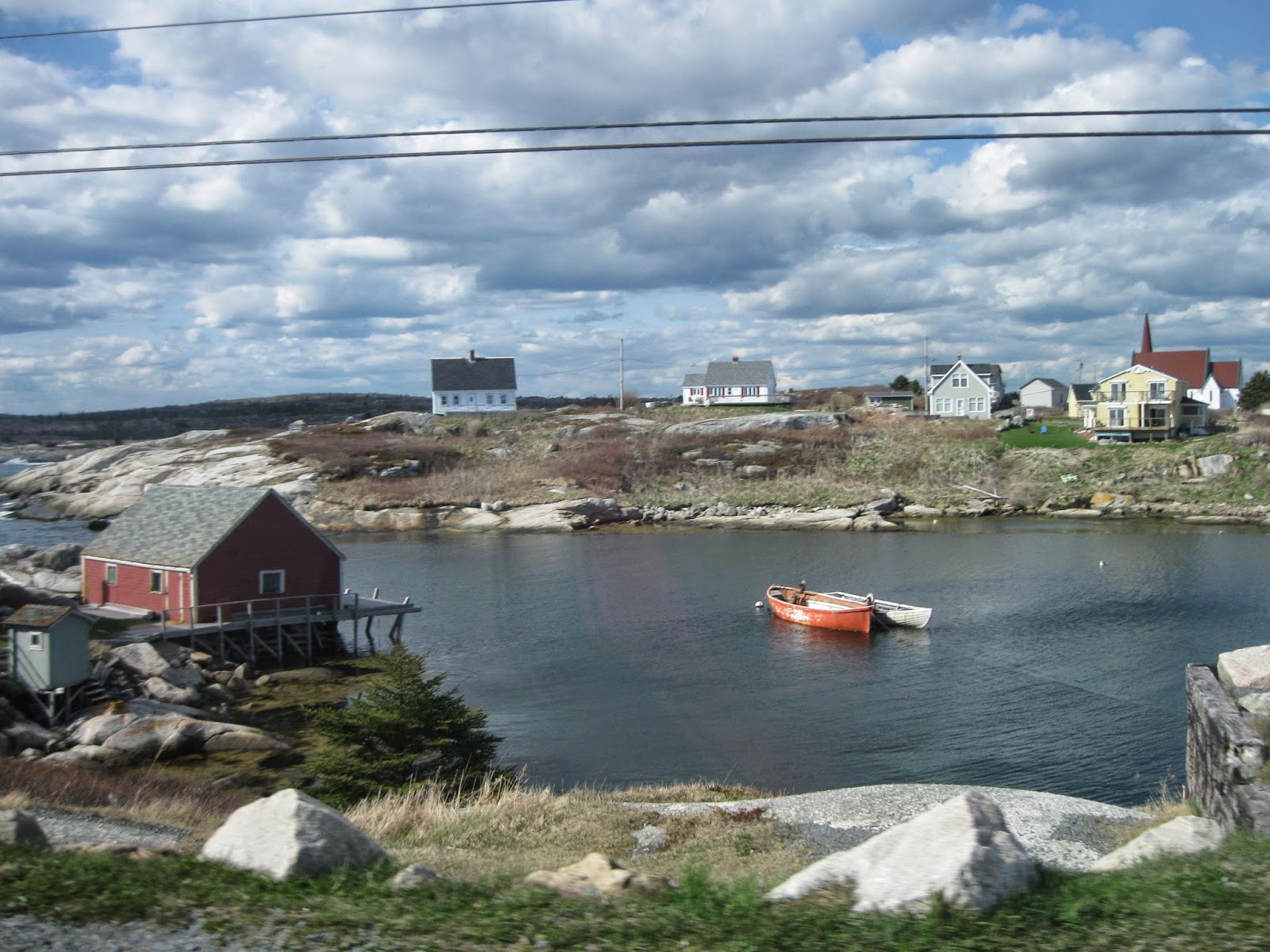
Later in the afternoon we decided to head out to Peggy's Cove. I had been there back in '72 with my parents but Owen had missed it in his '93 trip. Off we headed through little coastal towns and down windy roads. We got to Peggy's Cove. The wind was not too bad but it was still enough to satisfy my soul.
The sea gull in the last picture was quite well behaved. We checked the roof of the car (not ours) and he had left no reminders of his presence. We just thought it was neat to see a sea gull on top of a car and took the picture.
The power of the sea is amazing. I feel an affinity with the sea. Marie means salty water or salty tears. Its origins are with the sea goddess - Mari. I love sitting on the rocks with the wind blowing through my hair (this does not do wonders for the hair do) and watch the waves crash on the rocks. I also love the challenge of climbing on the rocks to get from one point to the other. I am in my elements here on the rocky coast. Still the quiet sun on a prairie meadow also speaks to my soul calming it and lulling me into peace. The harsh wind and rocky shores of the coast speak to me in a different way - the awesome and untamed wonder of God's creation.
We took a few moments to stop off at one of the memorials for Swiss Air Flight 111 on September 2, 1998. I sat quietly here thinking of the people on the plane and of the rescuers and spectators helpless to bring life to such a death scene. I can only imagine how people felt as they stood on that spot looking out to the sea knowing there was little they could do other than bring in what ever the ocean chose to give up.
Today we are headed to the wharf in Halifax.
Love and Prayers,
Amie
Monday, May 12, 2014
Friday, May 09, 2014
Prince Edward Island
We are now in Nova Scotia. We took a shuttle bus from Charlottetown right to Tammy's front door. We crossed the Confederation Bridge - 13 km long across the ocean. Not my idea of fun but there was very little wind so I was actually quite relaxed. The driver and a couple of passengers were quite chatty and supplied us with information and stories for most of the four hour trip. It is always wonderful to hear the local stories.

Yesterday was a full day of sight seeing and traveling. Owen and Rob were done with the convention - huge banquet on Wednesday night - and so we set off looking for adventure. PEI is just gearing up for tourist season so things are beginning to open.
We heard a cruise ship was docking so we headed down to the harbour to see it. While there Rob kindly took a picture of us for a friend who wanted it for her holiday album.
If you think I look cold - I was. The wind off the ocean is quite chilly. This is because the ocean around PEI (unlike around Nova Scotia) freezes in the winter. The ice has just melted so the water is quite cold. The wind picks up this cold as it blows across the water and kindly leaves it with me. Even Owen had to wear a jacket.
We started wandering back to the hotel. As mentioned our hotel is an old one. Lots of character. But then I found so many old character buildings on the island. It became a joke between Owen and me that I wanted to find a real fixer-upper and retire there with lots of work to keep Owen busy. Every old house we looked at became a house with potential. Here is a picture of our hotel.
On our way back we stopped off at Province house - the birthplace of Confederation. We watched a 17 minute video about the events of 1864 leading to 1867. It was quite interesting - giving details we hadn't learned in our social studies class in high school.


The first picture is Province House. The second picture is the table where ideas for confederation were discussed. Speakers were eloquent and passionate. The whole process took place around a week of relationship building (Hmmm. I wonder who consistently preaches about the importance of relationship building in moving forward as a church.) The third picture is the speaker's chair and clerks' table for the legislature. It amazed me how small the room actually was compared to the one in Saskatchewan. It looked quite cozy to me.
Our next stop was St. Dunstan's Roman Catholic Basilica. I took a bit of time here to light a candle for my two wonderful parishes.


Our next stop was All Soul's chapel at St. Peter's Anglican Cathedral for Matins. We were a little late but snuck in anyway.
The wood looks black but it is actually red mahogany. You can see the red in the arches. The black comes from when they used coal heat. The coal dust produced turned the red to the beautiful (I think) black colour it is now. The red in the arches is from an attempt to clean the coal dust off the wood. The project proved to be greater than anticipated and so was abandoned.
All Soul's was built after the death of a beloved rector. Two parishioners decided to build a chapel in his memory. It was then decided that it be named in memory of all who had died. The one side of the building has stain glass windows. All along the walls are pictures.

The first picture is in memory of two young children that died. The children are the ones on Jesus' knee. The second picture is the Holy Family. The models for this were the artist's own family. The older man to the side is the architect of the chapel.
We had a wonderful visit with a parishioner and the lay reader. Normally Mass would have followed Matins but the priest was sick and a lay reader filled in for the first service. We were also able to see the cathedral. We heard many stories about various things in the church as well as about current projects.


What amazed me is that this church is kept unlocked during the day. About 15 years ago there was an incident when there was some vandalism done. A fair sized man with a mental illness came into the chapel. He took the altar cross and tried to dig out a big stone at the top of one of the pillars. The cross was found on the floor bent out of shape. The congregation was able to send it to a church supply company and have it repaired. Two years later the same thing happened again. The church supply company told the congregation there was nothing they could do to repair the cross. Fortunately, they found someone more local who was able to give it a try. The cross was repaired. There was nothing that could be done about the scars at the back of the cross. The woman I was talking with thought that was quite appropriate. The church was kept locked after that. Gradually the congregation became comfortable leaving the door unlocked during tourist season again.
Another story was about the stain glass windows. Lead has a life span of about 100 years. A few years back the windows started to bow out. The congregation priced out how much it would cost to have them redone. To their dismay it was about $25,000 just to crate them for the shipping. There was no way they could afford that. They found someone more local who was willing to camp over two summers and work on the windows. The cost came to about $32,000. The money to pay for these windows was raised by picking bottles. There may have been something about fudge as well. The woman who was telling me the story also spoke about making fudge every Saturday and taking it to the staff at local businesses. Each business would be visited about once every six weeks.
One other story about windows. They cleaned the windows in the chapel a number years ago. Once again the culprit was the coal heating. They discovered a serpent in one of the windows. A visiting bishop remarked "Scratch the surface of anything and there will be the devil underneath."
It was proof of a small world when I discovered that one of the woman on the shuttle to Nova Scotia also went to St. Peter's.
Rob wanted to go for lunch at Georgetown about an hour away. We headed back to the hotel to get the car. Georgetown is about an hour out. The speed limit is 90 km/hr but we often had to go slower through frequent settled areas. You don't go far between places. We also found that the 90 was taken by drivers as a suggested speed. Even doing 110 we were passed frequently.
Georgetown tells part of the story of modern PEI. I found it interesting during the video at Province House that at the time of Confederation that PEI was one of the wealthier provinces. That isn't the case now. There are some wonderful houses but more frequently the houses we saw were in need of some TLC - giving Owen and me lots of resources for our game of picking which fixer-upper. Georgetown was a prime example of this. There were some beautifully restored or upkept houses and a fair number of very "tired" ones. One thing we noted though was how clean and tidy all the yards were. There was very little garbage laying around and all the yards were raked.
From Georgetown we headed back to Charlottetown so we could head out to Green Gables. On our way to Cavendish we passed through North Rustico. Our entertainer the night before had spoken of this place as his home town. He also tried to convince us that the Farmer's Bank there was actually the first Credit Union in Canada. Owen is not sure about this as he has always understood the first Credit Union to have been in Quebec. He was quite interested in seeing the building that had held the Farmer's Bank.

Owen was also fascinated by all the churches on the island and would take pictures each time we passed by one. This next picture was also taken at North Rustico. It is the oldest Catholic church on the island built in 1838.

Next stop was Green Gables. It was just in the process of being opened. Actually it was great being there without all the other tourists. We basically had the place to ourselves. We could experience it as the place it would have been when Anne of Green Gables was first written.


The first picture is the back of Green Gables. The second is the parlour. The third was taken for my mom who loved crocuses. The fourth is taken from the Haunted Woods. And the last is taken on Lover's Lane.
By now we were getting hungry so we headed back to Charlottetown for the guys to have their lobster feast. The one they had on Tuesday night only whet their appetite for more. We had heard wonderful things about a particular restaurant on the harbour front. It definitely lived up to its reputation. And the waiter was absolutely awesome especially because he made sure my coffee cup was never empty. He was wonderful to talk to - so full of tidbits of information. I have always found Maritimers the most hospitable of people. With one exception (The sit down lunch where the servers absolutely refused to give me coffee until desert time - never come between me and my coffee) I found they nearly bent over backwards to make sure we got everything we would ever need.
Love and Prayers,
Amie
Yesterday was a full day of sight seeing and traveling. Owen and Rob were done with the convention - huge banquet on Wednesday night - and so we set off looking for adventure. PEI is just gearing up for tourist season so things are beginning to open.
We heard a cruise ship was docking so we headed down to the harbour to see it. While there Rob kindly took a picture of us for a friend who wanted it for her holiday album.
If you think I look cold - I was. The wind off the ocean is quite chilly. This is because the ocean around PEI (unlike around Nova Scotia) freezes in the winter. The ice has just melted so the water is quite cold. The wind picks up this cold as it blows across the water and kindly leaves it with me. Even Owen had to wear a jacket.
We started wandering back to the hotel. As mentioned our hotel is an old one. Lots of character. But then I found so many old character buildings on the island. It became a joke between Owen and me that I wanted to find a real fixer-upper and retire there with lots of work to keep Owen busy. Every old house we looked at became a house with potential. Here is a picture of our hotel.
On our way back we stopped off at Province house - the birthplace of Confederation. We watched a 17 minute video about the events of 1864 leading to 1867. It was quite interesting - giving details we hadn't learned in our social studies class in high school.
The first picture is Province House. The second picture is the table where ideas for confederation were discussed. Speakers were eloquent and passionate. The whole process took place around a week of relationship building (Hmmm. I wonder who consistently preaches about the importance of relationship building in moving forward as a church.) The third picture is the speaker's chair and clerks' table for the legislature. It amazed me how small the room actually was compared to the one in Saskatchewan. It looked quite cozy to me.
Our next stop was St. Dunstan's Roman Catholic Basilica. I took a bit of time here to light a candle for my two wonderful parishes.
Our next stop was All Soul's chapel at St. Peter's Anglican Cathedral for Matins. We were a little late but snuck in anyway.
The wood looks black but it is actually red mahogany. You can see the red in the arches. The black comes from when they used coal heat. The coal dust produced turned the red to the beautiful (I think) black colour it is now. The red in the arches is from an attempt to clean the coal dust off the wood. The project proved to be greater than anticipated and so was abandoned.
All Soul's was built after the death of a beloved rector. Two parishioners decided to build a chapel in his memory. It was then decided that it be named in memory of all who had died. The one side of the building has stain glass windows. All along the walls are pictures.
The first picture is in memory of two young children that died. The children are the ones on Jesus' knee. The second picture is the Holy Family. The models for this were the artist's own family. The older man to the side is the architect of the chapel.
We had a wonderful visit with a parishioner and the lay reader. Normally Mass would have followed Matins but the priest was sick and a lay reader filled in for the first service. We were also able to see the cathedral. We heard many stories about various things in the church as well as about current projects.
What amazed me is that this church is kept unlocked during the day. About 15 years ago there was an incident when there was some vandalism done. A fair sized man with a mental illness came into the chapel. He took the altar cross and tried to dig out a big stone at the top of one of the pillars. The cross was found on the floor bent out of shape. The congregation was able to send it to a church supply company and have it repaired. Two years later the same thing happened again. The church supply company told the congregation there was nothing they could do to repair the cross. Fortunately, they found someone more local who was able to give it a try. The cross was repaired. There was nothing that could be done about the scars at the back of the cross. The woman I was talking with thought that was quite appropriate. The church was kept locked after that. Gradually the congregation became comfortable leaving the door unlocked during tourist season again.
Another story was about the stain glass windows. Lead has a life span of about 100 years. A few years back the windows started to bow out. The congregation priced out how much it would cost to have them redone. To their dismay it was about $25,000 just to crate them for the shipping. There was no way they could afford that. They found someone more local who was willing to camp over two summers and work on the windows. The cost came to about $32,000. The money to pay for these windows was raised by picking bottles. There may have been something about fudge as well. The woman who was telling me the story also spoke about making fudge every Saturday and taking it to the staff at local businesses. Each business would be visited about once every six weeks.
One other story about windows. They cleaned the windows in the chapel a number years ago. Once again the culprit was the coal heating. They discovered a serpent in one of the windows. A visiting bishop remarked "Scratch the surface of anything and there will be the devil underneath."
It was proof of a small world when I discovered that one of the woman on the shuttle to Nova Scotia also went to St. Peter's.
Rob wanted to go for lunch at Georgetown about an hour away. We headed back to the hotel to get the car. Georgetown is about an hour out. The speed limit is 90 km/hr but we often had to go slower through frequent settled areas. You don't go far between places. We also found that the 90 was taken by drivers as a suggested speed. Even doing 110 we were passed frequently.
Georgetown tells part of the story of modern PEI. I found it interesting during the video at Province House that at the time of Confederation that PEI was one of the wealthier provinces. That isn't the case now. There are some wonderful houses but more frequently the houses we saw were in need of some TLC - giving Owen and me lots of resources for our game of picking which fixer-upper. Georgetown was a prime example of this. There were some beautifully restored or upkept houses and a fair number of very "tired" ones. One thing we noted though was how clean and tidy all the yards were. There was very little garbage laying around and all the yards were raked.
From Georgetown we headed back to Charlottetown so we could head out to Green Gables. On our way to Cavendish we passed through North Rustico. Our entertainer the night before had spoken of this place as his home town. He also tried to convince us that the Farmer's Bank there was actually the first Credit Union in Canada. Owen is not sure about this as he has always understood the first Credit Union to have been in Quebec. He was quite interested in seeing the building that had held the Farmer's Bank.
Owen was also fascinated by all the churches on the island and would take pictures each time we passed by one. This next picture was also taken at North Rustico. It is the oldest Catholic church on the island built in 1838.
Next stop was Green Gables. It was just in the process of being opened. Actually it was great being there without all the other tourists. We basically had the place to ourselves. We could experience it as the place it would have been when Anne of Green Gables was first written.
The first picture is the back of Green Gables. The second is the parlour. The third was taken for my mom who loved crocuses. The fourth is taken from the Haunted Woods. And the last is taken on Lover's Lane.
By now we were getting hungry so we headed back to Charlottetown for the guys to have their lobster feast. The one they had on Tuesday night only whet their appetite for more. We had heard wonderful things about a particular restaurant on the harbour front. It definitely lived up to its reputation. And the waiter was absolutely awesome especially because he made sure my coffee cup was never empty. He was wonderful to talk to - so full of tidbits of information. I have always found Maritimers the most hospitable of people. With one exception (The sit down lunch where the servers absolutely refused to give me coffee until desert time - never come between me and my coffee) I found they nearly bent over backwards to make sure we got everything we would ever need.
Love and Prayers,
Amie
Wednesday, May 07, 2014
Our Holidays
At the suggestion of my secretary, (and I have the most unique, awesome secretary ever) I am going to start this blog again - at least until my holidays are over.
Monday's flight was pretty uneventful. I left Saskatoon at 5:45 and arrived in Charlottetown about nine hours later. There was a minor blip in the Toronto airport where my boarding pass misnamed the gate from which I was to depart. Fortunately I caught the error in time and made it to the proper gate with time to spare.
I had a couple of conversations with young moms on the plane. The babies were three and four months old. They were taking them back to see relatives. They were flying from Edmonton. The young man in front of me worked at Cold Lake. I wondered if this was a sign of how many Maritimers have come out West looking for work.
The weather when we landed in Charlottetown was drizzly and cool but at least it wasn't the snow they had earlier in the day. The airport here is quite small so one actually walks outside to get from the airplane to the terminal. Charlottetown has approximately 35,000 people, which puts it maybe at the size of Lloydminister. The whole Island is about 132,000 or so. Boggles my mind - the whole island has less people than Saskatoon. But, as we all know, I like small places.
There is a sense of age and peace here. We are staying at the Rodd Hotel in the downtown. This is an old hotel somewhat like the Hotel Saskatchewan in Regina. I share my lunches with the guys at the convention. It is about a five block walk to the Delta where the convention is held. The Delta is right next to the harbour. The lunches are way more fancy than what I am used to but it takes them forever to serve me a cup of coffee. We had to ask three times yesterday and even then it was done according to whatever they deemed the proper time to be. Today I was much smarter and stopped off at a small coffee shop and grabbed a coffee to go. Good thing too. I never did get served my coffee. Owen, being the awesome husband he is, wandered off with my empty cup and returned with a full one.
There are many restaurants in this area of the city. We had fish on Monday night. The little place we were in understood the gluten-free diet so ordering was easy. Owen ordered two pieces of fish and barely made it on the outside of them. The portions are huge compared to the prairies. And the amount of fries is unreal - real homemade fries - yum. I could make a meal of them alone.
I had breakfast in Summerside on Tuesday morning. It was at the Silver Fox Curling and Yacht Club. It was a Rotary meeting. I introduced myself and was later asked to say a few words if I had any. I stood up and told them about the places I serve and the Rotary club there. I received a flag to take home for the Rotary club there.
I had coffee and a long chat with an old friend. She had worked for Owen in Outlook. She and her husband kindly took Sara in when we abandoned her in Grade 12 so that we could move to Landis. It was good to get caught up. (In a world of coincidences we had just met her daughter the week before. Owen and I were dealing with the medical exam for our life insurance and were pleasantly surprised to find that our examiner was this friend's daughter.)
Last night we went to an "all you can eat lobster" meal. Owen decided to order the smaller - two lobster plate. The lobsters were fairly small but once again the fries were plenty. I couldn't decide if I like the regular fries or the sweet potato fries better. So I ate a number of both. Being from Alberta now,I supported the ranchers in my area by eating good old beef - only because the menu did not have salmon, which is my preference.
Today is the major banquet. We are trying to figure what local delicacy it will feature. Tomorrow we are headed to Georgetown after going to Matins at All Soul's Chapel here in Charlottetown. Owen and I will get some pictures taken and posted for our friends at St. Thomas and St. Mary's.
Love and Prayers,
Amie
Monday's flight was pretty uneventful. I left Saskatoon at 5:45 and arrived in Charlottetown about nine hours later. There was a minor blip in the Toronto airport where my boarding pass misnamed the gate from which I was to depart. Fortunately I caught the error in time and made it to the proper gate with time to spare.
I had a couple of conversations with young moms on the plane. The babies were three and four months old. They were taking them back to see relatives. They were flying from Edmonton. The young man in front of me worked at Cold Lake. I wondered if this was a sign of how many Maritimers have come out West looking for work.
The weather when we landed in Charlottetown was drizzly and cool but at least it wasn't the snow they had earlier in the day. The airport here is quite small so one actually walks outside to get from the airplane to the terminal. Charlottetown has approximately 35,000 people, which puts it maybe at the size of Lloydminister. The whole Island is about 132,000 or so. Boggles my mind - the whole island has less people than Saskatoon. But, as we all know, I like small places.
There is a sense of age and peace here. We are staying at the Rodd Hotel in the downtown. This is an old hotel somewhat like the Hotel Saskatchewan in Regina. I share my lunches with the guys at the convention. It is about a five block walk to the Delta where the convention is held. The Delta is right next to the harbour. The lunches are way more fancy than what I am used to but it takes them forever to serve me a cup of coffee. We had to ask three times yesterday and even then it was done according to whatever they deemed the proper time to be. Today I was much smarter and stopped off at a small coffee shop and grabbed a coffee to go. Good thing too. I never did get served my coffee. Owen, being the awesome husband he is, wandered off with my empty cup and returned with a full one.
There are many restaurants in this area of the city. We had fish on Monday night. The little place we were in understood the gluten-free diet so ordering was easy. Owen ordered two pieces of fish and barely made it on the outside of them. The portions are huge compared to the prairies. And the amount of fries is unreal - real homemade fries - yum. I could make a meal of them alone.
I had breakfast in Summerside on Tuesday morning. It was at the Silver Fox Curling and Yacht Club. It was a Rotary meeting. I introduced myself and was later asked to say a few words if I had any. I stood up and told them about the places I serve and the Rotary club there. I received a flag to take home for the Rotary club there.
I had coffee and a long chat with an old friend. She had worked for Owen in Outlook. She and her husband kindly took Sara in when we abandoned her in Grade 12 so that we could move to Landis. It was good to get caught up. (In a world of coincidences we had just met her daughter the week before. Owen and I were dealing with the medical exam for our life insurance and were pleasantly surprised to find that our examiner was this friend's daughter.)
Last night we went to an "all you can eat lobster" meal. Owen decided to order the smaller - two lobster plate. The lobsters were fairly small but once again the fries were plenty. I couldn't decide if I like the regular fries or the sweet potato fries better. So I ate a number of both. Being from Alberta now,I supported the ranchers in my area by eating good old beef - only because the menu did not have salmon, which is my preference.
Today is the major banquet. We are trying to figure what local delicacy it will feature. Tomorrow we are headed to Georgetown after going to Matins at All Soul's Chapel here in Charlottetown. Owen and I will get some pictures taken and posted for our friends at St. Thomas and St. Mary's.
Love and Prayers,
Amie
Friday, June 10, 2011
Changes
If anyone out there has been following these sporadic posts over the months and years, they may note that I have changed the name and discription. I had already changed the purpose/description in my disclaimer on the side. The name change refers to how I understand the Source of all that is.
I have started reading J. Philip Newell's "Echo of the Soul." In his introduction he writes:
" ... the analogy of royal garments woven throughwith gold. If the golden thread were to be ripped out of the clothing the whole garment would unravel. So it is with the image of God woven into the mystery of our being. If somehow it were to be extracted we would cease to exist. The image of God is not simply a characteristic of our humanity. It is the essence of our being ..."
Someone, in an interview for position of incumbent, once asked - you talk about God alot. Who is God to you. I simply replied - the Source of all that is - without God there is nothing. I still firmly believe that. It is understanding what that means in my personal faith life and in my life as a priest with which I struggle. Often the conflict comes between what I intuitively feel/believe and what those around me put forth as tradition/doctrine. In spite of my struggles, I hold unto the Golden Thread. Or maybe it is holding onto the Golden Thread that keeps me going forward through all my struggles - keeps me in my faith and in my church.
Love and Prayers,
Ann Marie
I have started reading J. Philip Newell's "Echo of the Soul." In his introduction he writes:
" ... the analogy of royal garments woven throughwith gold. If the golden thread were to be ripped out of the clothing the whole garment would unravel. So it is with the image of God woven into the mystery of our being. If somehow it were to be extracted we would cease to exist. The image of God is not simply a characteristic of our humanity. It is the essence of our being ..."
Someone, in an interview for position of incumbent, once asked - you talk about God alot. Who is God to you. I simply replied - the Source of all that is - without God there is nothing. I still firmly believe that. It is understanding what that means in my personal faith life and in my life as a priest with which I struggle. Often the conflict comes between what I intuitively feel/believe and what those around me put forth as tradition/doctrine. In spite of my struggles, I hold unto the Golden Thread. Or maybe it is holding onto the Golden Thread that keeps me going forward through all my struggles - keeps me in my faith and in my church.
Love and Prayers,
Ann Marie
Wednesday, June 08, 2011
Reflection - Part 6
We carry baggage today because we have not seen the Gospels through the lens of the earlier Hebrew writings, the traditions and understandings of which they came out, but rather through the lens of a community or communities struggling to define themselves as separate from the world. These communities may have shared a past with the traditions that formed Jesus but they did not share a future with them. They firmly believed the times were going to end. Their focus was not on bringing radical change to a world but rather to keep themselves for the end of the world. This is contrary to what Jesus preached.
It may well have been that Jesus did believe the end would come shortly after his death and resurrection. But it did not stop Jesus from reaching into the world and meeting people where they were rather than requiring people to jump through hoops to come to him. Once again Diarmaid MacCulloch writes:
Still, Jesus was a Jew immersed in the traditions that constituted the identity of his fellow Jews. He is recorded as taking a cavalier attitude to the Jewish Law or obeying its demands in ways that seem capricious, which caused anxious debate for generations about how far Christians
should imitate him, and which are still puzzling after much very sophisticated modern analysis of the mixture. Maybe the answer is that Jesus did not care a great deal about being consistent on the issue, given his concentration on the imminent coming of the kingdom, in which all laws would be made anew.
Or maybe it was the spirit of the law that Jesus followed rather than the letter – especially as it had been minutely defined by the various sects. Hence he healed on the Sabbath because his understanding that the spirit of the law was compassion and especially compassion for the vulnerable and those in need. Certainly the daughter of Abraham whom he healed was at no immediate risk but he saw her suffering and healed her so that she would not experience for even an instance longer – an example from which our medical system might benefit.
Maybe we as a church need to live in an end times mentality. There is no guaranteed tomorrow to complete our work, only today. If our work, based on the Gospels seen as a continuation of the prophetic tradition rather than solely through the lens of the Epistles, is to be working for the bringing in of the kingdom, as Jesus’ work was, then we need to act now to reach out and relieve the suffering around us. Not by waiting for those people to jump through the hoops and become one of us but by meeting them where they are and celebrating them for who they are – beloved children of God.
Instead of looking at a God that insists hoops be jumped through we could take the example of the father of the prodigal son – who seeing his wayward son approaching in the distance ran to embrace him rather than waiting for him to go through requirements and grovelling. We tend to be more like the other son – wanting some sort of requirements or accountability before the wayward son is accepted back into the fold.
Maybe we should look at the example of Jesus who, although he met people in the synagogue, went out into the highways and byways like the man with the wedding banquet and gathered people in to share in the meal – people who had not jumped through hoops or met requirements. The only qualification was that they existed and were invited – and all that were met were invited.
So at the beginning I said I might reach some conclusion. Typically, for me, I have not. So be it. The thoughts are there for further pondering. But for now, I have a vestry agenda to plan and a funeral service to put together. I may find time to reflect later on. Who knows.
It may well have been that Jesus did believe the end would come shortly after his death and resurrection. But it did not stop Jesus from reaching into the world and meeting people where they were rather than requiring people to jump through hoops to come to him. Once again Diarmaid MacCulloch writes:
Still, Jesus was a Jew immersed in the traditions that constituted the identity of his fellow Jews. He is recorded as taking a cavalier attitude to the Jewish Law or obeying its demands in ways that seem capricious, which caused anxious debate for generations about how far Christians
should imitate him, and which are still puzzling after much very sophisticated modern analysis of the mixture. Maybe the answer is that Jesus did not care a great deal about being consistent on the issue, given his concentration on the imminent coming of the kingdom, in which all laws would be made anew.
Or maybe it was the spirit of the law that Jesus followed rather than the letter – especially as it had been minutely defined by the various sects. Hence he healed on the Sabbath because his understanding that the spirit of the law was compassion and especially compassion for the vulnerable and those in need. Certainly the daughter of Abraham whom he healed was at no immediate risk but he saw her suffering and healed her so that she would not experience for even an instance longer – an example from which our medical system might benefit.
Maybe we as a church need to live in an end times mentality. There is no guaranteed tomorrow to complete our work, only today. If our work, based on the Gospels seen as a continuation of the prophetic tradition rather than solely through the lens of the Epistles, is to be working for the bringing in of the kingdom, as Jesus’ work was, then we need to act now to reach out and relieve the suffering around us. Not by waiting for those people to jump through the hoops and become one of us but by meeting them where they are and celebrating them for who they are – beloved children of God.
Instead of looking at a God that insists hoops be jumped through we could take the example of the father of the prodigal son – who seeing his wayward son approaching in the distance ran to embrace him rather than waiting for him to go through requirements and grovelling. We tend to be more like the other son – wanting some sort of requirements or accountability before the wayward son is accepted back into the fold.
Maybe we should look at the example of Jesus who, although he met people in the synagogue, went out into the highways and byways like the man with the wedding banquet and gathered people in to share in the meal – people who had not jumped through hoops or met requirements. The only qualification was that they existed and were invited – and all that were met were invited.
So at the beginning I said I might reach some conclusion. Typically, for me, I have not. So be it. The thoughts are there for further pondering. But for now, I have a vestry agenda to plan and a funeral service to put together. I may find time to reflect later on. Who knows.
Reflections - Part 5
So I guess Paul does have a lot to teach about being church in today’s context. By learning how to live in community we also to grow to a greater understanding of what that means. It can help us reach out into the communities around us.
Diarmaid MacCulloch writes:
The separate inspiration of much of Paul’s message … was bound to bring tensions with the Jerusalem leadership … At stake was an issue which would trouble Christ-followers for 150 years: how far should they move
from Jewish tradition if, like Paul, they preached the good news of Christ’s
kingdom to non-Jews? Questions of deep symbolism arose: should converts accept such features of Jewish life as circumcision, strict adherence to the Law of Moses and abstention from food defiled by association with pagan worship …? Paul would allow only that Christians should not eat food which they knew had been publically offered to idols, and otherwise not make much of a fuss about wares on sale in the market or about dishes at a non-believer’s table.
I wonder what impact following Paul’s lead would have on the practice of open communion that seems to be in controversy today – especially after the statement from the Canadian House of Bishops. It is all fine and dandy to say that we don’t have to ask whether or not a person is baptized when they come to the rail for communion. That is the equivalent of “don’t ask, don’t tell.” It does not provide consistency. Basically it says that we can practice open communion as long as we don’t do it knowingly. But as soon as we become aware we are not to practice it. So what happens then if I give someone communion on a regular basis and then find out they are not baptized. Of course, I would speak to them about baptism but am I to quit giving them communion when they have already received. Seems I am shutting the barn door after the horse got out. On second thought, maybe our bishops are following Paul’s example. Don’t eat the meat offered to idols but if you don’t ask and don’t know – it is okay.
It seems to me that if we follow Jesus’ example we would practice the meal as open to everyone. I am not aware of any place in the Gospels where Jesus insisted people be baptized in order to share the meal with him. There are no indications in the words of institution in Paul’s letter to the Corinthians or in the Gospels that the people who shared the last supper had to be baptized. It may well be that they all were as this was Jesus’ inner circle. But I am not even sure that baptism was a requirement for his community or whether it was later written in by his followers. We have no record of Jesus himself baptizing which seems strangely at odds with his commission that his disciples should go out and baptize the nations. Even the reading for Pentecost this year does not call on the disciples to baptize.
I am well aware that baptism as a requirement for full entry into the Church was a requirement very early on in the history of the Church. But I wonder if it wasn’t more an adaptation of the culture around it and maybe based on its Jewish roots. Circumcision was a requirement of the Jewish faith – an outward sign of belonging. The mystery religions of the time had an impact on the early Church and they had initiation rites.
I remember in seminary learning that the night before baptism the catechumens were given the secret. This secret was so secret that our professor had to finally tell us that it was the Apostles’ Creed as we couldn’t find any place that named it. It seems to me that Jesus, with his breaking down of barriers to a personal relationship with God, would not have put other barriers in place. I would, however, recognize a very human need to have some mark or rite of passage to belonging to the community.
Interestingly enough I recently researched the origin of the word “narthex.” Narthex is from a word referring to the giant fennel herb. I couldn’t, for the life of me, make a connection with the early church until I read that it was often used in initiation rites. Further research indicated that fire had been brought to earth in the hollowed out stem of this herb. Since fire was so significant to human development there is a connection with initiation. Early catechumens were made to stay in the Narthex for services until they were baptized. Some traditions had the doors being closed and locked before the reading of the Gospel. This would appear to be a very human requirement as I firmly believe Jesus would not have denied anyone the good news.
Diarmaid MacCulloch writes:
The separate inspiration of much of Paul’s message … was bound to bring tensions with the Jerusalem leadership … At stake was an issue which would trouble Christ-followers for 150 years: how far should they move
from Jewish tradition if, like Paul, they preached the good news of Christ’s
kingdom to non-Jews? Questions of deep symbolism arose: should converts accept such features of Jewish life as circumcision, strict adherence to the Law of Moses and abstention from food defiled by association with pagan worship …? Paul would allow only that Christians should not eat food which they knew had been publically offered to idols, and otherwise not make much of a fuss about wares on sale in the market or about dishes at a non-believer’s table.
I wonder what impact following Paul’s lead would have on the practice of open communion that seems to be in controversy today – especially after the statement from the Canadian House of Bishops. It is all fine and dandy to say that we don’t have to ask whether or not a person is baptized when they come to the rail for communion. That is the equivalent of “don’t ask, don’t tell.” It does not provide consistency. Basically it says that we can practice open communion as long as we don’t do it knowingly. But as soon as we become aware we are not to practice it. So what happens then if I give someone communion on a regular basis and then find out they are not baptized. Of course, I would speak to them about baptism but am I to quit giving them communion when they have already received. Seems I am shutting the barn door after the horse got out. On second thought, maybe our bishops are following Paul’s example. Don’t eat the meat offered to idols but if you don’t ask and don’t know – it is okay.
It seems to me that if we follow Jesus’ example we would practice the meal as open to everyone. I am not aware of any place in the Gospels where Jesus insisted people be baptized in order to share the meal with him. There are no indications in the words of institution in Paul’s letter to the Corinthians or in the Gospels that the people who shared the last supper had to be baptized. It may well be that they all were as this was Jesus’ inner circle. But I am not even sure that baptism was a requirement for his community or whether it was later written in by his followers. We have no record of Jesus himself baptizing which seems strangely at odds with his commission that his disciples should go out and baptize the nations. Even the reading for Pentecost this year does not call on the disciples to baptize.
I am well aware that baptism as a requirement for full entry into the Church was a requirement very early on in the history of the Church. But I wonder if it wasn’t more an adaptation of the culture around it and maybe based on its Jewish roots. Circumcision was a requirement of the Jewish faith – an outward sign of belonging. The mystery religions of the time had an impact on the early Church and they had initiation rites.
I remember in seminary learning that the night before baptism the catechumens were given the secret. This secret was so secret that our professor had to finally tell us that it was the Apostles’ Creed as we couldn’t find any place that named it. It seems to me that Jesus, with his breaking down of barriers to a personal relationship with God, would not have put other barriers in place. I would, however, recognize a very human need to have some mark or rite of passage to belonging to the community.
Interestingly enough I recently researched the origin of the word “narthex.” Narthex is from a word referring to the giant fennel herb. I couldn’t, for the life of me, make a connection with the early church until I read that it was often used in initiation rites. Further research indicated that fire had been brought to earth in the hollowed out stem of this herb. Since fire was so significant to human development there is a connection with initiation. Early catechumens were made to stay in the Narthex for services until they were baptized. Some traditions had the doors being closed and locked before the reading of the Gospel. This would appear to be a very human requirement as I firmly believe Jesus would not have denied anyone the good news.
Reflections - Part 4
Unfortunately, we read Jesus and the Incarnation through the lens of the Epistles which is less of a ‘kingdom’ lens and more of a personal lens. So we, as a Church, tend to emphasize the difference Jesus and the Christian way makes in our individual lives. I have come to believe that this is one of the things that makes the Church more inward looking. We focus on the intellect (which is also a reflection of the influence of the societies in which the early Church struggled – intellect was part of the male and therefore superior. Experience, life lived in the messiness of the world was more the realm of the feminine and therefore inferior – a bit simplistic way of putting it, I realize.) I know a very dear woman with the heart of a deacon who constantly struggles with the structures of the church that see outreach as a pouring out of money rather than an engaging in the community around us. In this way, I very much feel my vows as a deacon – even though they were as a transitional deacon. I don’t see my vows as a priest changing the focus of my vows as a deacon but rather as a broadening.
We tend to hold ourselves distant from the struggles of the community around us. For St. George’s, and this is true of many churches, those struggles are separate from us because most of us do not live in the community in which our church is situated. Case in point being that although I serve in a core community, I live in a new suburb almost as far removed from the realities of my geographical parish as I can be.
Paul taught us well on how to live in Christian community. But Paul did not do much to teach how to continue Jesus’ incarnational ministry in the larger community context. Jesus did but we tend to follow Paul’s emphasis rather than Jesus'. Is it any wonder that we can’t get our congregations to look beyond themselves. For years we have taught through the lens of Paul’s writings. Even the call to discipleship in the Gospels is seen in that light.
And it might even be one of the reasons why so many people have cut their connections with the Church. They don’t see a continuity. The teachings and the call to the Christian life are not reflecting the reality in which they live. But this is not something we can blame Paul for. Paul, interestingly enough, was the one that reached outside the traditions of the church to be relevant to the larger community around him. (Did I mention that I live in a creative tension with Paul and his letters). It was actually the Jerusalem Church that wanted people to conform to the Jewish traditions ie. circumcision.
We tend to hold ourselves distant from the struggles of the community around us. For St. George’s, and this is true of many churches, those struggles are separate from us because most of us do not live in the community in which our church is situated. Case in point being that although I serve in a core community, I live in a new suburb almost as far removed from the realities of my geographical parish as I can be.
Paul taught us well on how to live in Christian community. But Paul did not do much to teach how to continue Jesus’ incarnational ministry in the larger community context. Jesus did but we tend to follow Paul’s emphasis rather than Jesus'. Is it any wonder that we can’t get our congregations to look beyond themselves. For years we have taught through the lens of Paul’s writings. Even the call to discipleship in the Gospels is seen in that light.
And it might even be one of the reasons why so many people have cut their connections with the Church. They don’t see a continuity. The teachings and the call to the Christian life are not reflecting the reality in which they live. But this is not something we can blame Paul for. Paul, interestingly enough, was the one that reached outside the traditions of the church to be relevant to the larger community around him. (Did I mention that I live in a creative tension with Paul and his letters). It was actually the Jerusalem Church that wanted people to conform to the Jewish traditions ie. circumcision.
Reflections - Part 3
I read the Gospels through the lens of the prophets. I do not see the prophets as pointing to the coming of Jesus. I see the Gospels using the prophets as a way of pointing out who Jesus was to those earliest Christian communities. I see the prophets as expanding on the purpose of the Law. People were not getting that God was about justice – not justice as we understand it today which is largely about avoiding sin and when we do sin we are punished for it. The justice we tend to practice today is largely retributive rather than restorative. This definitely reflects the Latin roots of the early church as the Hebrew roots were more about restoration – for example the idea of Jubilee.
Throughout the prophets – as harsh as they often appear – is the idea of justice with compassion. We can clearly see God’s agonizing over God’s beloved children and how they just don’t get it. The error of their ways often has to do with their disregard for the most vulnerable in society.
This is reflected in the Incarnation. Jesus continued the prophetic tradition. He was solidly rooted in the Law but based his following of the law on justice with compassion. We see echoes of the prophets in his agonizing over how people just don’t get it. I am solidly with the writer of John when he/she states that whoever has seen Jesus has seen God. Wow! What a wonderful God that is. When one looks at the Incarnation and the deep compassion that Jesus has for all that he meets – okay, maybe not always right away; the Syro-Phoenican woman being a case in point – one cannot help but understand what it means when he says that he comes to bring life and bring it abundantly.
Last Sunday, based on something David Lose said on Working Preacher.org, I preached on how we were called into the same intimate relationship with God that Jesus had. That relationship is not just based on belief but on participating. David Lose talks about the Ascension being the original Rapture and Left-Behind. Only in this case to be left behind was an honour and a privilege not a indication of imperfection. We are left behind to continue in Jesus work in the bringing in of the kingdom. Jesus tells us that we shall do even greater things than those which we see him doing. For Jesus it is not just about living our individual and corporate lives in a right manner – it is about working to bring about a change to all of creation – about restoring things to the original created state.
Throughout the prophets – as harsh as they often appear – is the idea of justice with compassion. We can clearly see God’s agonizing over God’s beloved children and how they just don’t get it. The error of their ways often has to do with their disregard for the most vulnerable in society.
This is reflected in the Incarnation. Jesus continued the prophetic tradition. He was solidly rooted in the Law but based his following of the law on justice with compassion. We see echoes of the prophets in his agonizing over how people just don’t get it. I am solidly with the writer of John when he/she states that whoever has seen Jesus has seen God. Wow! What a wonderful God that is. When one looks at the Incarnation and the deep compassion that Jesus has for all that he meets – okay, maybe not always right away; the Syro-Phoenican woman being a case in point – one cannot help but understand what it means when he says that he comes to bring life and bring it abundantly.
Last Sunday, based on something David Lose said on Working Preacher.org, I preached on how we were called into the same intimate relationship with God that Jesus had. That relationship is not just based on belief but on participating. David Lose talks about the Ascension being the original Rapture and Left-Behind. Only in this case to be left behind was an honour and a privilege not a indication of imperfection. We are left behind to continue in Jesus work in the bringing in of the kingdom. Jesus tells us that we shall do even greater things than those which we see him doing. For Jesus it is not just about living our individual and corporate lives in a right manner – it is about working to bring about a change to all of creation – about restoring things to the original created state.
Reflections - Part 2
One of my first discoveries after going through a year of BCP was that the readings are from the epistles and the gospels with the rare exception to prove the rule. Off hand I can remember one reading from Isaiah and I am too lazy to go back through and count the exceptions.
I had a time of fellowship with a couple of retired priests, one being my father. One of them made the comment that we tend to read the Gospels through the lens of the Epistles – especially Paul’s letters – rather than the Epistles through the lens of the Gospels.
I know that for a number of scholars the fact that Paul’s letters were written before the Gospels speaks to them of the Epistles being closer to the teachings of the early church. But let us consider this. Paul, after his conversion took off to Arabia for three years. He did not go to the people closest to the source – Jesus. We are not sure what exactly he did for those three years. We also know that Paul was often on the outs with the disciples who experienced Jesus in the flesh. Paul did not spend a lot of time in Jerusalem, closest to the source, but was a Jew of the Diaspora. That coloured a lot of his thinking and the lens through which he saw Jesus. I am beginning to wonder if we can legitimately base our understandings of the early church and its understandings of Jesus based on Paul’s letters. Maybe James’ letter is actually a better lens (and I will admit to a bias for James’ letter).
Of course being of a more Protestant tradition – I grew up in a more evangelical Anglican congregation (although my father’s early mentors were more of a Anglo-Catholic background which makes my background an interesting mixture) – Paul’s letters very much influenced the theology with which I grew up – maybe not so much the theology I learned from my parents but definitely the theology of the Church around me. My background has always held me in a creative tension with those letters. The social justice – action in the world – keeps me closer to James (and let us remember the Paul had real issues with the Church in Jerusalem headed by James) but I worshipped in a world dominated by Paul. My colleague's comment about reading the Gospels through Paul’s letters made sense to me in my current challenges with the Church.
Part of the tension is the recognition that as much as I have problems with Paul, it is probably due to Paul’s reaching out to the Gentiles that Christianity eventually flourished. (or maybe I am doing God a dis-service. It may well have been that another vehicle would have been found and it would have been a different base on which Christianity flourished – who knows.)
Another of my more current understandings of Paul is that for Paul the end times were just around the corner. I am currently reading Diarmaid MacCaulloch’s Christianity The First Three Thousand Years. On page 114 he writes:
… Christianity was not usually going to make a radical challenge to existing
social distinctions. The was that Paul and his followers assumed that the
world was going to come to an end soon and so there was not much point
in trying to improve it by radical action.
… He made notably little reference in his letters to the ‘kingdom of God’, that concept of a radical turn to world history which had meant so much to Jesus and had accompanied his challenge to so many existing social conventions.
Paul only experienced Jesus in a personal revelation rather than in community and incarnation. He was very Jewish and it can appear that he fit his understandings of Jesus into that tradition. He did not benefit from travelling and listening to Jesus and having Jesus challenge his understandings as Jesus did for the disciples.
So we end up with a lens of focus on personal salvation with end times coming soon. Although, to be fair, one can see a dealing with the failure of the end times to come in Paul’s later letters. Sometimes, when I read the letters, I wonder if there is real continuity with the Gospels.
The Church became preoccupied with individual salvation. My colleague made another interesting point. Paul’s understanding of atonement was largely based on the Fall or original sin. We now understand those stories to be myths - attempts to understand how in a world created by God there can be so much wrong. Paul’s understanding was that Jesus’ main role was to bring about the return to our origins before the eating of the fruit. In the main, Paul’s emphasis was on living a life of personal rightness – not so much calling society to account.
I happen to believe that as well. But I see it more through the lens of the prophets. Somehow, something went wrong in creation. Probably it had a lot to do with humankind’s wilfulness. I see the law trying to set guidelines/rules about how to live in a manner that benefits all of creation. The Ten Commandments are very important in how to live individually within community but the Law is more than the Ten. It also looks at living as a community in a larger context.
I love the Summary of the Law in the BCP – ‘on these two commandments hang all the law and the prophets.’ When saying morning prayer at the 10:30 service I almost always use the Hear, O Israel rather than the Apostles’ Creed. It places God at the centre but speaks to the fact that we can only have God placed at the centre when we live in right relationship with those around us. Paul does have some insights as to how to live that out in context of Christian community but maybe not so much on how to live and effect change in the context of living in and transforming the larger community around us.
My colleague suggested that we should actually be reading the Epistles through the lens of the Gospel rather than vice-versa. It makes sense to me. In that light, I can see how Paul enriches our understanding of living our faith incarnationally in our faith communities and in the larger communities around us.
I had a time of fellowship with a couple of retired priests, one being my father. One of them made the comment that we tend to read the Gospels through the lens of the Epistles – especially Paul’s letters – rather than the Epistles through the lens of the Gospels.
I know that for a number of scholars the fact that Paul’s letters were written before the Gospels speaks to them of the Epistles being closer to the teachings of the early church. But let us consider this. Paul, after his conversion took off to Arabia for three years. He did not go to the people closest to the source – Jesus. We are not sure what exactly he did for those three years. We also know that Paul was often on the outs with the disciples who experienced Jesus in the flesh. Paul did not spend a lot of time in Jerusalem, closest to the source, but was a Jew of the Diaspora. That coloured a lot of his thinking and the lens through which he saw Jesus. I am beginning to wonder if we can legitimately base our understandings of the early church and its understandings of Jesus based on Paul’s letters. Maybe James’ letter is actually a better lens (and I will admit to a bias for James’ letter).
Of course being of a more Protestant tradition – I grew up in a more evangelical Anglican congregation (although my father’s early mentors were more of a Anglo-Catholic background which makes my background an interesting mixture) – Paul’s letters very much influenced the theology with which I grew up – maybe not so much the theology I learned from my parents but definitely the theology of the Church around me. My background has always held me in a creative tension with those letters. The social justice – action in the world – keeps me closer to James (and let us remember the Paul had real issues with the Church in Jerusalem headed by James) but I worshipped in a world dominated by Paul. My colleague's comment about reading the Gospels through Paul’s letters made sense to me in my current challenges with the Church.
Part of the tension is the recognition that as much as I have problems with Paul, it is probably due to Paul’s reaching out to the Gentiles that Christianity eventually flourished. (or maybe I am doing God a dis-service. It may well have been that another vehicle would have been found and it would have been a different base on which Christianity flourished – who knows.)
Another of my more current understandings of Paul is that for Paul the end times were just around the corner. I am currently reading Diarmaid MacCaulloch’s Christianity The First Three Thousand Years. On page 114 he writes:
… Christianity was not usually going to make a radical challenge to existing
social distinctions. The was that Paul and his followers assumed that the
world was going to come to an end soon and so there was not much point
in trying to improve it by radical action.
… He made notably little reference in his letters to the ‘kingdom of God’, that concept of a radical turn to world history which had meant so much to Jesus and had accompanied his challenge to so many existing social conventions.
Paul only experienced Jesus in a personal revelation rather than in community and incarnation. He was very Jewish and it can appear that he fit his understandings of Jesus into that tradition. He did not benefit from travelling and listening to Jesus and having Jesus challenge his understandings as Jesus did for the disciples.
So we end up with a lens of focus on personal salvation with end times coming soon. Although, to be fair, one can see a dealing with the failure of the end times to come in Paul’s later letters. Sometimes, when I read the letters, I wonder if there is real continuity with the Gospels.
The Church became preoccupied with individual salvation. My colleague made another interesting point. Paul’s understanding of atonement was largely based on the Fall or original sin. We now understand those stories to be myths - attempts to understand how in a world created by God there can be so much wrong. Paul’s understanding was that Jesus’ main role was to bring about the return to our origins before the eating of the fruit. In the main, Paul’s emphasis was on living a life of personal rightness – not so much calling society to account.
I happen to believe that as well. But I see it more through the lens of the prophets. Somehow, something went wrong in creation. Probably it had a lot to do with humankind’s wilfulness. I see the law trying to set guidelines/rules about how to live in a manner that benefits all of creation. The Ten Commandments are very important in how to live individually within community but the Law is more than the Ten. It also looks at living as a community in a larger context.
I love the Summary of the Law in the BCP – ‘on these two commandments hang all the law and the prophets.’ When saying morning prayer at the 10:30 service I almost always use the Hear, O Israel rather than the Apostles’ Creed. It places God at the centre but speaks to the fact that we can only have God placed at the centre when we live in right relationship with those around us. Paul does have some insights as to how to live that out in context of Christian community but maybe not so much on how to live and effect change in the context of living in and transforming the larger community around us.
My colleague suggested that we should actually be reading the Epistles through the lens of the Gospel rather than vice-versa. It makes sense to me. In that light, I can see how Paul enriches our understanding of living our faith incarnationally in our faith communities and in the larger communities around us.
Reflections - Part 1
I make no claims to being a scholar. I try to keep up with some reading to continue my education. Usually I try to take a few hours a week in my field office (Mel’s Café) with a book. Some weeks I get no reading done as I spend a fair amount of time interacting with the regulars and building relationships with the community. I tend to be more of relational and experiential priest than an academic.
Being at St. George’s has been a challenge in a number of ways. I give thanks for Biggar as it helped me discover who I am as a priest and develop the skills and experiences for the ministry to which I have come believe God called me. Biggar helped me discover, St. George’s is helping me to grow more fully into that priest in the context of a Church that may not be quite ready for that type of ministry.
I have always struggled with Paul. My mother and I would get on a rant about Paul and my father would just shake his head at us and call us heretics. But both of them brought me to read the Gospels through the lens of social justice and the prophetic tradition. Because Dad was my priest for the first 20 years of my life I didn’t even realize that there might be different lens until I was about 18 and out in the world a little more.
While at St. George’s I am becoming re-acquainted with the BCP including the readings on any given Sunday. My early morning service on Sunday is the Service of Holy Communion out of the BCP. In keeping with that service I do use the lessons in the prayer book rather than the Revised Common Lectionary. It often means two different sermons on a Sunday morning which can be a challenge but I am discovering a few of my challenges are making more sense.
Given that a fair number of my congregation have gray hair, and usually they are the ones that are most hesitant to change, becoming reacquainted with our traditions through the BCP has been a real blessing as it is helping me to better understand where they come from. Granted St. George’s uses the Book of Alternative Services as its main resource for worship but most of the older members were formed by the BCP.
So where am I going with this meandering? I am trying to piece together in my mind some of the issues over resistance to reach out more consciously into our communities. So this will probably be the beginning of a few posts as I try to work through what I have so far. It is by no means academic as I make no claims to being an academic (I have come to believe that placing most of our emphasis on academic understandings has helped keep us from a practice of incarnational faith in our communities. We will send money but often will not give of ourselves. I respect the academics as they often provide the thoughts that spark my thinking but I do believe they need to be balanced by experience as well as theory.) As I am a “right brain” person it will appear to meander at times but will eventually reach a conclusion – I hope.
Being at St. George’s has been a challenge in a number of ways. I give thanks for Biggar as it helped me discover who I am as a priest and develop the skills and experiences for the ministry to which I have come believe God called me. Biggar helped me discover, St. George’s is helping me to grow more fully into that priest in the context of a Church that may not be quite ready for that type of ministry.
I have always struggled with Paul. My mother and I would get on a rant about Paul and my father would just shake his head at us and call us heretics. But both of them brought me to read the Gospels through the lens of social justice and the prophetic tradition. Because Dad was my priest for the first 20 years of my life I didn’t even realize that there might be different lens until I was about 18 and out in the world a little more.
While at St. George’s I am becoming re-acquainted with the BCP including the readings on any given Sunday. My early morning service on Sunday is the Service of Holy Communion out of the BCP. In keeping with that service I do use the lessons in the prayer book rather than the Revised Common Lectionary. It often means two different sermons on a Sunday morning which can be a challenge but I am discovering a few of my challenges are making more sense.
Given that a fair number of my congregation have gray hair, and usually they are the ones that are most hesitant to change, becoming reacquainted with our traditions through the BCP has been a real blessing as it is helping me to better understand where they come from. Granted St. George’s uses the Book of Alternative Services as its main resource for worship but most of the older members were formed by the BCP.
So where am I going with this meandering? I am trying to piece together in my mind some of the issues over resistance to reach out more consciously into our communities. So this will probably be the beginning of a few posts as I try to work through what I have so far. It is by no means academic as I make no claims to being an academic (I have come to believe that placing most of our emphasis on academic understandings has helped keep us from a practice of incarnational faith in our communities. We will send money but often will not give of ourselves. I respect the academics as they often provide the thoughts that spark my thinking but I do believe they need to be balanced by experience as well as theory.) As I am a “right brain” person it will appear to meander at times but will eventually reach a conclusion – I hope.
Thursday, March 17, 2011
Happy St. Patrick's Day


One year ago today I sat in the bar with a friend listening to the band her boys played in. We had first met in a local cafe a few years back when I met another friend for coffee. My family and I had gone to that cafe off and on since that time and often Toni was our waitress. By the time I had moved to the city she had retired by came to cafe daily as a best friend of the owner.
The owner of the cafe has Parkinson's and it got to be too much for her so she sold the business. When it was first sold, Toni, that night in the bar, suggested that the community regulars at the cafe needed a place to meet. Between us the idea of a community coffee house meeting out of St. George's was born. It opened up mid-April and is totally self-supporting. It has donated a total of $1370 to St. George's in the form of cash for projects and a freezer.
At Christmas we put together three Christmas hampers for community members. We have donated to a project of the Legion that meets at St. George's and are preparing a donation to the Station 20 West project.
The coffee house is run solely on donations. People donate muffins, cookies, coffee etc. When no one has donated and supplies run low we will buy what we need. A bowl is placed out for people who want to donate to both supplies and the various projects we designate the funds for.
We have our regulars - both community people and church people. I try to be there as much as possible piggy-backing the time with my office hours. It is amazing the mixed community that has formed.
Last Thursday one of the community members suggested that we host another potluck like we did at Christmas. I suggested that it be this Thursday as it was St. Patrick's Day. And so it came to be.
It was wonderful. The table was laden with food. There was talking and sharing and laughter. There were door prizes. I am presently wearing a lovely huge green St. Patrick's Day tie that someone had won and left behind.
This is what church is. A place of gathering for all people. A place where people feel safe to come and share. One of the life-giving things for me is that it provides a venue for people to talk to me that normally wouldn't seek me out in my church office or meet me for coffee. The informal, almost chance met, atmosphere provides that feeling that they are not being preached at nor do they feel that they are formally seeking help. I love it when they draw me aside just to have me listen to what they need to share, what they need to get off their chests. For me, this is incarnational ministry. For many at the coffee house, this is as close as they are willing to get to a church. Regardless of whether they enter the actual nave of the church, they know that the church is there for them. And they know this because of the opening of the doors freely into the community - no cost, no strings, - just a place to gather and be who they are and accepted as the marvelous human beings they have become - in all their health and in all their brokeness.
Wednesday, March 09, 2011
Have you got a minute - sit with me
I truly believe these are some of my most treasured moments as a priest. And they don't happen in a church. But rather the quiet after the rush in a local coffee shop. Or in a crowded noisey diner.
I love my calling - maybe not so much as a priest in a religious institution but as an ordinary person called by God to reach out in a hurt and broken world.
About nine months ago I sat in what has now become my regular diner - basically an early morning field office. I was relatively fresh from a rural context where I had an active community ministry supported by the people of my parish. I had been coming to this city diner for about two or three months. The only person I really talked to was my waitress.
I sat there and questioned God - Is this where I am suppose to be coming? I come here and sit in isolation time after time. I don't believe I am accomplishing anything here. - The answer was - keep coming.
Over the last few months I have managed to build a few relationships. I have even been invited to sit at the "staff" table a couple of times. And then today - there it was - "Have you got a minute - sit with me."
Love and Prayers,
Ann Marie
I love my calling - maybe not so much as a priest in a religious institution but as an ordinary person called by God to reach out in a hurt and broken world.
About nine months ago I sat in what has now become my regular diner - basically an early morning field office. I was relatively fresh from a rural context where I had an active community ministry supported by the people of my parish. I had been coming to this city diner for about two or three months. The only person I really talked to was my waitress.
I sat there and questioned God - Is this where I am suppose to be coming? I come here and sit in isolation time after time. I don't believe I am accomplishing anything here. - The answer was - keep coming.
Over the last few months I have managed to build a few relationships. I have even been invited to sit at the "staff" table a couple of times. And then today - there it was - "Have you got a minute - sit with me."
Love and Prayers,
Ann Marie
Thursday, April 29, 2010
Monday, April 26, 2010
Celebrating Natality
I am reading Diarmund O'Murchu's "Catching up with Jesus: A Gospel Story for Our Time." So far I am quite enjoying it as it is giving me things to think about. This following put into words some of what I celebrate.
According to O'Murchu, Grace Jantzen proposes that "Redemption comes not through mortality with the emphasis on death and suffering but through natality celebrating the birthing, flourishing, and growth of everything in creation."
I thought about this. Death is something that is certain and relatively predictable. No we can't predict the exact moments nor in the long run can we fully control death but death is something that comes to all things. Birth is uncertain and unpredictable. Human beings tend to prefer the certain and predictable even when that means death. Witness how so many of our churches are shrinking into closure because death is preferable to the unknown of what might happen if we actually try something new.
But this idea of redemption being in natality really speaks to me. I have always had a problem with the emphasis on the cross and suffering. I much prefer to find things to celebrate - to look for the many blessings big and small in our lives and the world around that speak to God's ongoing presence and working. I do not believe that creation is finished but is ongoing. When the Kin-dom is complete so will creation be complete. And I don't see the coming in of the Kin-dom as an apocalyptic event but rather a growing of the cosmos into the purposes for which God created it and a coming of the world of Shalom here on earth.
In seminary we had to study Rowan Williams' book "The Wound of Knowledge." Now I will readily admit that with my problems trying to understand the written word I struggled to make sense of the book. It took me a couple of reads in order to "see" what Williams was trying to say (I may have mentioned before that I see in concepts, images, visions and find understanding the written word difficult unless the author is deliberately drawing word pictures). I do remember discussing one of the chapters in class. It had been about Augustine and how he believed that God was found in our weak times - in our cross moments. I argued that for Augustine, a male of some stature, those moments would not have been the norm and so it was legitimate for him to believe that God was most often found in them. But as a woman, times of powerlessness, of vulnerablity etc. were not so rare. I usually find God in the powerful moments spent in creation - both in the outdoors with bright warm sunshine and a lovely breeze or whipping wind and in the creating process of craft work.
It is interesting that if we look at this redemption in natality idea, women are more ideally situated traditionally to experience it. We are the ones to go through the pain and uncertainty of giving physical birth. We are the ones who are sterotypically considered the nurturers of relationship. These things, as part of our norm, can lead into a shared experience with the Creating Divine.
The emphasis on the cross and suffering carries with it the major views of atonement which centre around sin and judgement. It models and power over, an authority based relationship and a separation of the sacred and the secular. It is about control, and distance and it tends to keep things in the head rather than embodied.
What happens if our emphasis is on natality? We begin to focus on embodiedment, on incarnation and relationship. We tend to celebrate life and open ourselves to wondrous possibilities. We experience the awe and mystery of the various relationships with the Divine. Instead of trying to understand in a scientific manner we tend to feel the awe and mystery with a sense of euphoric oneness. The more intellectual model tends to focus on separation with a sense of our littleness in connection with an all powerful male God.
The embodied understanding that can come out of a celebration of natality helps lead us in a "seeing"/experiencing of the sacred in all things. This is my style of spirituality. I don't keep regular prayer habits or practices. Instead, I celebrate and try to open myself to the presence of the Divine all day. I have certain practices that I do when I want to do this in a deliberate manner. These practices usually involve embodiment. They usually involve more than one or two of the senses. And very rarely do they involve structured prayer or reading. They might involve music and meditation, which I have learned help me to open myself to the awe and mystery. In the warmer weather I try to do these practices outside sitting on the ground with the warmth of the sunshine and a breeze flowing past me. I find that this is the time that I am closest to the Divine.
Whether this is an outcome of the what I was taught about the relationship between the Divine and the individual and also with all other parts of creation or whether I needed to have these experiences to more fully understand the beliefs I was taught as a child, I am not sure. But I believe that my growing faith and my practices are definitely intermeshed. This celebration of natality as O'Murchu calls is has helped me form my ministry style. I can see the Divine at work in all things.
It does mean that I rarely talk about sin. It is not that I don't believe that we sin, that we cause separation between God and us and between us and others on a regular basis. I just don't believe that constantly pointing out where we fail accomplishes a huge amount in the long run. I have experienced the harm it does in a way less than full relationship with God as a young adult. I could not pray or participate in various ways in a service because I was no where near worthy enough. I prefer to celebrate the ways in which God is active in our lives and the lives of others around us. When I develop relationships with people I focus on the good within them. It is not that I am unaware of the edges, I just don't let that colour my interactions. I prefer to respond to the good and foster the development of that.
Natality lends itself more easily to a power with scenario. It lends itself to the uncertainty of being with people as they journey through life and walking with them in their struggles listening to them and stepping back far enough for them to make the decisions they need to make. It means facing those outcomes with them rather than taking charge when we feel they are wrong and criticizing when the outcomes are less than perfect.
It lends itself to a more inclusive acceptance of people. Part of this is because instead of holding the masculine up as the ultimate goal as our Christian faith has traditionally done (based not so much on the Scriptures as on the erroneous theories of pagan philosophers, something I find so totally ironic when people call me a heretic) it celebrates all aspects of the human sexuality. There is no fear of the feminine that leads to a need to treat woman differently in so many unjust ways and that also leads to a fear of homosexuality and its challenge to traditional understandings of male/female roles. There is an understanding that creation needs both male and female equally, that each person has gifts that contribute to the creating process in important ways - that the reality is we need all in order to create.
I think it also leads to a better way of growing into the mission to which God calls us. We are better able to step out trusting in the uncertainty of future as we try new things. We are better able to let go and trust in God. We don't end up locked inside our church buildings afraid to face the unpredictable world outside them.
Love and Prayers,
Ann Marie
According to O'Murchu, Grace Jantzen proposes that "Redemption comes not through mortality with the emphasis on death and suffering but through natality celebrating the birthing, flourishing, and growth of everything in creation."
I thought about this. Death is something that is certain and relatively predictable. No we can't predict the exact moments nor in the long run can we fully control death but death is something that comes to all things. Birth is uncertain and unpredictable. Human beings tend to prefer the certain and predictable even when that means death. Witness how so many of our churches are shrinking into closure because death is preferable to the unknown of what might happen if we actually try something new.
But this idea of redemption being in natality really speaks to me. I have always had a problem with the emphasis on the cross and suffering. I much prefer to find things to celebrate - to look for the many blessings big and small in our lives and the world around that speak to God's ongoing presence and working. I do not believe that creation is finished but is ongoing. When the Kin-dom is complete so will creation be complete. And I don't see the coming in of the Kin-dom as an apocalyptic event but rather a growing of the cosmos into the purposes for which God created it and a coming of the world of Shalom here on earth.
In seminary we had to study Rowan Williams' book "The Wound of Knowledge." Now I will readily admit that with my problems trying to understand the written word I struggled to make sense of the book. It took me a couple of reads in order to "see" what Williams was trying to say (I may have mentioned before that I see in concepts, images, visions and find understanding the written word difficult unless the author is deliberately drawing word pictures). I do remember discussing one of the chapters in class. It had been about Augustine and how he believed that God was found in our weak times - in our cross moments. I argued that for Augustine, a male of some stature, those moments would not have been the norm and so it was legitimate for him to believe that God was most often found in them. But as a woman, times of powerlessness, of vulnerablity etc. were not so rare. I usually find God in the powerful moments spent in creation - both in the outdoors with bright warm sunshine and a lovely breeze or whipping wind and in the creating process of craft work.
It is interesting that if we look at this redemption in natality idea, women are more ideally situated traditionally to experience it. We are the ones to go through the pain and uncertainty of giving physical birth. We are the ones who are sterotypically considered the nurturers of relationship. These things, as part of our norm, can lead into a shared experience with the Creating Divine.
The emphasis on the cross and suffering carries with it the major views of atonement which centre around sin and judgement. It models and power over, an authority based relationship and a separation of the sacred and the secular. It is about control, and distance and it tends to keep things in the head rather than embodied.
What happens if our emphasis is on natality? We begin to focus on embodiedment, on incarnation and relationship. We tend to celebrate life and open ourselves to wondrous possibilities. We experience the awe and mystery of the various relationships with the Divine. Instead of trying to understand in a scientific manner we tend to feel the awe and mystery with a sense of euphoric oneness. The more intellectual model tends to focus on separation with a sense of our littleness in connection with an all powerful male God.
The embodied understanding that can come out of a celebration of natality helps lead us in a "seeing"/experiencing of the sacred in all things. This is my style of spirituality. I don't keep regular prayer habits or practices. Instead, I celebrate and try to open myself to the presence of the Divine all day. I have certain practices that I do when I want to do this in a deliberate manner. These practices usually involve embodiment. They usually involve more than one or two of the senses. And very rarely do they involve structured prayer or reading. They might involve music and meditation, which I have learned help me to open myself to the awe and mystery. In the warmer weather I try to do these practices outside sitting on the ground with the warmth of the sunshine and a breeze flowing past me. I find that this is the time that I am closest to the Divine.
Whether this is an outcome of the what I was taught about the relationship between the Divine and the individual and also with all other parts of creation or whether I needed to have these experiences to more fully understand the beliefs I was taught as a child, I am not sure. But I believe that my growing faith and my practices are definitely intermeshed. This celebration of natality as O'Murchu calls is has helped me form my ministry style. I can see the Divine at work in all things.
It does mean that I rarely talk about sin. It is not that I don't believe that we sin, that we cause separation between God and us and between us and others on a regular basis. I just don't believe that constantly pointing out where we fail accomplishes a huge amount in the long run. I have experienced the harm it does in a way less than full relationship with God as a young adult. I could not pray or participate in various ways in a service because I was no where near worthy enough. I prefer to celebrate the ways in which God is active in our lives and the lives of others around us. When I develop relationships with people I focus on the good within them. It is not that I am unaware of the edges, I just don't let that colour my interactions. I prefer to respond to the good and foster the development of that.
Natality lends itself more easily to a power with scenario. It lends itself to the uncertainty of being with people as they journey through life and walking with them in their struggles listening to them and stepping back far enough for them to make the decisions they need to make. It means facing those outcomes with them rather than taking charge when we feel they are wrong and criticizing when the outcomes are less than perfect.
It lends itself to a more inclusive acceptance of people. Part of this is because instead of holding the masculine up as the ultimate goal as our Christian faith has traditionally done (based not so much on the Scriptures as on the erroneous theories of pagan philosophers, something I find so totally ironic when people call me a heretic) it celebrates all aspects of the human sexuality. There is no fear of the feminine that leads to a need to treat woman differently in so many unjust ways and that also leads to a fear of homosexuality and its challenge to traditional understandings of male/female roles. There is an understanding that creation needs both male and female equally, that each person has gifts that contribute to the creating process in important ways - that the reality is we need all in order to create.
I think it also leads to a better way of growing into the mission to which God calls us. We are better able to step out trusting in the uncertainty of future as we try new things. We are better able to let go and trust in God. We don't end up locked inside our church buildings afraid to face the unpredictable world outside them.
Love and Prayers,
Ann Marie
Tuesday, April 20, 2010
My Attitude Problem
Although many may not agree - I am usually pretty laid back about things. There are a few issues about which my passion and enthusiasm show. Evangelism is one of them but that is fairly recent. Justice has always been something I have been passionate about. It is a passion that is a gift from my parents who believe/believed strongly in a world of Shalom.
I also care deeply about the Anglican Church. I remember leading a seminar at college that was about Anglicanism in other parts of the world. I researched with dismay growing each time I read about the growing influence of the Global South provinces and where their theology lay. I could see even then the impact they would have on the Anglican Communion and nearly wept for the way I knew we would change. It is not that I don't believe they shouldn't have a voice. It is that I believe they are where we were about 40 years ago. I firmly believe that in time all will come to realize that God is fully inclusive and that human sexuality is diverse and part of how we are created. I honestly feel that this will not be a huge issue in 20 years. We will have moved on to something else just a challenging to us as a Communion. Because we live in very different contexts there will never be a "common mind." To expect that we could ever have such a thing is ridiculous. We are far too diverse.
As much as I love the Anglican Church and its historical ties I cannot support the sacrificing of justice for the idol of unity. The ABC recently did a video for the Global South Conference.
Archbishop's Address
It is interesting the connection I feel with Canterbury. I have long believed that more than just physical traits are passed through our DNA. I believe that some of our spiritual ones are as well. I am a direct descendant of Queen Bertha of Kent whose husband gifted with St. Martins for Augustine. This makes Canterbury a special place for me. But, as much as it is special, I cannot continue to feel the necessity to continue to hold to it as a centre of unity at the sacrifice of justice.
As a child and teen-ager I was often in trouble with authority figures. I didn't realize until I had a daughter of my own that shared my attitude problem just what it was that caused the trouble. As an adult, dealing with that daughter's teachers, I realized that what I saw as issues of justice (and therefore I would not back down and was often taken to task for speaking back) were considered discipline issues to the teachers because I was challenging their authority. I never could back down from what I believed to be right. I still can't. I firmly believe that full inclusion of GLBTTs is what is right - that it is a matter of justice and that God is about justice. As a result if the ACC and TEC have to face consequences for their stance on this issue - so be it. I would rather see that than to see us uphold a very false unity.
And that is what it would be - a false unity based on the sacrifice of people and justice. How can it be a true unity with one group calling the shots and another having to sacrifice what it truly believes is the will of God? How can it be a true unity when it cannot embrace the diverseness that exists within it - when groups of it are not able to have integrity with their firmly held beliefs?
And as to consequences for ACC and TEC on a Communion level - what about Wales and Scotland and New Zealand? What about the voices in the C of E calling out for justice and full inclusion. If it is a matter of ACC and Tec facing consequences, what about those who share that passion and attitude for the same things? The reality is that we are just the tip of the iceberg. Maybe others are being relatively quiet right now but start to infringe on their sense of justice and their sense of integrity and we may see that the current sacrificing of justice for the idol of false unity will have more far-reaching consequences than Lambeth ever envisioned. We may see that they to have an attitude problem.
Love and Prayers,
Ann Marie +
I also care deeply about the Anglican Church. I remember leading a seminar at college that was about Anglicanism in other parts of the world. I researched with dismay growing each time I read about the growing influence of the Global South provinces and where their theology lay. I could see even then the impact they would have on the Anglican Communion and nearly wept for the way I knew we would change. It is not that I don't believe they shouldn't have a voice. It is that I believe they are where we were about 40 years ago. I firmly believe that in time all will come to realize that God is fully inclusive and that human sexuality is diverse and part of how we are created. I honestly feel that this will not be a huge issue in 20 years. We will have moved on to something else just a challenging to us as a Communion. Because we live in very different contexts there will never be a "common mind." To expect that we could ever have such a thing is ridiculous. We are far too diverse.
As much as I love the Anglican Church and its historical ties I cannot support the sacrificing of justice for the idol of unity. The ABC recently did a video for the Global South Conference.
Archbishop's Address
It is interesting the connection I feel with Canterbury. I have long believed that more than just physical traits are passed through our DNA. I believe that some of our spiritual ones are as well. I am a direct descendant of Queen Bertha of Kent whose husband gifted with St. Martins for Augustine. This makes Canterbury a special place for me. But, as much as it is special, I cannot continue to feel the necessity to continue to hold to it as a centre of unity at the sacrifice of justice.
As a child and teen-ager I was often in trouble with authority figures. I didn't realize until I had a daughter of my own that shared my attitude problem just what it was that caused the trouble. As an adult, dealing with that daughter's teachers, I realized that what I saw as issues of justice (and therefore I would not back down and was often taken to task for speaking back) were considered discipline issues to the teachers because I was challenging their authority. I never could back down from what I believed to be right. I still can't. I firmly believe that full inclusion of GLBTTs is what is right - that it is a matter of justice and that God is about justice. As a result if the ACC and TEC have to face consequences for their stance on this issue - so be it. I would rather see that than to see us uphold a very false unity.
And that is what it would be - a false unity based on the sacrifice of people and justice. How can it be a true unity with one group calling the shots and another having to sacrifice what it truly believes is the will of God? How can it be a true unity when it cannot embrace the diverseness that exists within it - when groups of it are not able to have integrity with their firmly held beliefs?
And as to consequences for ACC and TEC on a Communion level - what about Wales and Scotland and New Zealand? What about the voices in the C of E calling out for justice and full inclusion. If it is a matter of ACC and Tec facing consequences, what about those who share that passion and attitude for the same things? The reality is that we are just the tip of the iceberg. Maybe others are being relatively quiet right now but start to infringe on their sense of justice and their sense of integrity and we may see that the current sacrificing of justice for the idol of false unity will have more far-reaching consequences than Lambeth ever envisioned. We may see that they to have an attitude problem.
Love and Prayers,
Ann Marie +
Tuesday, April 06, 2010
Love One Another As I Have Loved You.
Fulton MS: The World’s Cruelest Town
I was checking out the various blogs I follow today and came across the above link at Grandmere Mimi’s. I followed it and my heart and soul wept. Especially when I persevered and finally reached the original posts on the Facebook page, Constance Quit Your Crying, mentioned. But I was sick in my soul even before that.
A couple of days ago, a young woman came to me about a text she had received from a male friend. What that young man had written was completely unacceptable in any context. As this woman is someone very near and dear to me I struggled with my feelings around this young man who I had never met. I had to watch what I was wishing for, filtering it through the lens of my being a priest and doing or even wishing something that was inappropriate on any level. I finally settled on praying that this young man would see the harm in his actions and choose not to hurt another young woman in the way he had hurt this one.
It is so hard to separate ourselves from our very human tendency to lash out when something hurts our hearts or our souls. And many of us are hurt by what we see as injustice. Originally, I was only perturbed by the news of the above false prom, not only on Constance’s behalf but also on behalf of the other students who were set apart. But then, as I read more and more of the comments by supporters of Constance I became perturbed by the lack of love and tact within those writing.
There were some decent comments, rightly pointing out the wrongness of having a fake prom. But a vast number of comments were inflammatory. I noticed a fair number tarring all people from Mississippi with the same brush. That is unfair. The comments tended to see things in terms of black and white. Because this incident happened in Mississippi, then all things there must not be good. Even within the people who thought up this bizarre and hateful action there is good. Even in the midst of their fear, they do love and they do good. This action was totally wrong. They did harm – not only to Constance and the other students but also, in the long run, to themselves. The negative stereotypic comments were not helpful.
Part of the reason why they are not helpful is that those who respond with fear and hate, as I believe happened in Fulton, do so because they already feel insecure about their world. They dig in and become more rigid. The more negativity they have to face the more defensive they become. Inflammatory comments fuel a persecution complex. The current fad is to respond to negativity by making oneself out to be the victim and to claim that one is being persecuted. One can see this if one perseveres and reads through to the original comments on the Facebook page. The students did not see wrong in what they did but only saw that they were victims because their prom was canceled. The more extreme comments criticizing their actions will not help in bringing an understanding in how they were wrong to participate in the weekends events and will heighten a sense of being misunderstood,isolation and persecution by the outside world "that just does not understand what really happened."
Another thing that disturbed me about the comments where the way some of the people were so personally scathing of the students who went to the “real” prom. There was name calling galore and nasty comments about dress and behaviour. The dress and behaviour were not that different from many another school prom and, yes, it is not appropriate but to demonize these young people for something many others do is not appropriate either.
Way back when I took a couple of night classes for my second year of university we had someone come to talk to us about cults. He told us that if someone from a cult approached us we should not respond out fear or hate or be rude and cut them off. The best thing we could do would be to invite them in for a drink and snack. The young people from the cult at our door were taught that the world is an evil place and when we respond negatively we reinforce that perception. When we respond with love and care we may possibly be sowing a seed that will help if/when the person starts to question their cult.
This does not mean that it is wrong to point out to the young people of Fulton that what they did was wrong on so many levels and that it not only harmed Constance and the other students at the fake prom, it also harmed them. But that should be done in a loving manner, in a way that may cause them to stop and think about their actions in a different light rather than dig in and defend their actions thus reinforcing the fear and hatred. I worry that the line between those who participated in the what happened in Fulton and those who criticize their actions is not that great. It just so happens that they are each at opposites ends of the issue but the language and the response is very similar.
I hold all who have been touched by this incident in my heart and my prayers. I pray that we may all become aware of how potentially harmful our actions and responses may be and work to remember that God loves all the children God created. If we place God between us and those with whom we disagree maybe we can respond with the love which that our Lord and Saviour commanded of us just last Thursday as he ate with his disciples and washed their feet.
Love and Prayers,
Ann Marie
Thursday, April 01, 2010
Good News
A few years back a friend of mine resigned his position because he could no longer, in good conscience, say no to blessing same sex marriages. This meant that he was not able to act officially in any capacity as a priest.
The good news is that Shawn is once again going to be able to preside and preach. It does not mean that he is licensed once again (as he is remaining true to his convictions and that means that he cannot follow all the present canons of the ACC), rather that he has been given a letter of permission to preside and preach under the authority of the current bishop. As he is now a parishioner of mine the bishop has allowed for him to preside and preach under my direction. I am absolutely thrilled to say that he has agreed to take the 9 am Easter Sunday service in our Memorial Chapel. It will also be the first service in our chapel in a while as it was used for storage when I arrived. We are reclaiming the space as sacred at our Holy Saturday service (which Shawn and I are doing jointly) and the first Service of Holy Communion will be on Sunday.
So, this Sunday not only will I be celebrating the Resurrection joyously but also the marvelous ways that God has blessed my life recently.
Love and prayers,
Ann Marie
The good news is that Shawn is once again going to be able to preside and preach. It does not mean that he is licensed once again (as he is remaining true to his convictions and that means that he cannot follow all the present canons of the ACC), rather that he has been given a letter of permission to preside and preach under the authority of the current bishop. As he is now a parishioner of mine the bishop has allowed for him to preside and preach under my direction. I am absolutely thrilled to say that he has agreed to take the 9 am Easter Sunday service in our Memorial Chapel. It will also be the first service in our chapel in a while as it was used for storage when I arrived. We are reclaiming the space as sacred at our Holy Saturday service (which Shawn and I are doing jointly) and the first Service of Holy Communion will be on Sunday.
So, this Sunday not only will I be celebrating the Resurrection joyously but also the marvelous ways that God has blessed my life recently.
Love and prayers,
Ann Marie
Saturday, March 06, 2010
A Purple Bow Blessing
I had a rough Wednesday and Thursday this week. I started in my new parish at the beginning of February. I was hired to bring about change and to help the church reach into the local community around them. There are times I wonder if what I am doing is effective and I get filled with doubts. I push getting out and doing things so strongly and then wonder - what if I am wrong to do so? What if it is not what these people are to do? What if, by pushing and sounding like a broken record, I am doing the very thing that can divide a congregation as you have people who are looking for the changes and others who need to maintain the more recent traditional understanding of being church (ie. 1950's style)?
I decided on Thursday that I needed to take a break and get away from it. So early Firday morning I went back home to Biggar. I caught an early ride out with my husband and my son. They dropped me off in Biggar on their way to Landis. I went into the first of my more favourite coffee spots. This is what I found.
In the morning this table is full of men. (The photo was taken in the afternoon lull.) The owner of this coffee shop placed the purple bow (purple is my signature colour) on the wall in memory of my time spent in her cafe.
I knew about this bow before I went in as she had told me what she had done on facebook and my husband and son had seen it when they went in for supper one night. Its presence touches me deeply. It touches me on a personal level - that I managed to make a mark that they want to remember. But most importantly it is a re-affirmation of what I have been preaching to the church for the past number of years. We need to get out of our buildings and get to where the people are. And it may not (and probably will not) translate into more bums in the pews and money in the plate and workers for our traditional projects but it will reach out to the people that God is calling us to reach out to.
These are the people that need to know that God (and the church) cares about them unconditionally. These are the people who need to hear the good news. It is not that we sit there among them and preach ad nauseum. It that we become a caring presence in their midst, sharing their joys and trials. I could tell of experience after experience of reaching people where they needed to be reached all because I was accessible to them. Not because I have any specific talents or even that I have any illusions that I am a super good priest but because I was there. I was there for them to turn to when they needed someone to help them deal with the various events in their lives. I was there when things where going relatively smoothly.
But it wasn't just about my being present. It was very much about my being a representative of a church and, more importantly, of a God that truly cared about all people. One of the conversations I had with a man from coffee row shortly after I announced that I would be leaving Biggar will always be treasured deeply in my heart. This man - a wonderful human being but definitely not a church goer - said to me - you don't know what an impact you have made on this community. When I replied that I hadn't done a whole lot he responded - just your presence among us, your willingness to be there made a difference. He tied it in with the presence of the church coming among them.
I was blessed with a wonderful congregation in Biggar. They could have complained about the amount of time I spent outside of the the church. They could have pointed out that this time was not showing monetary or people in church results and was not time well spent. But they did not. They even gave contributions at Christmas to fund my ministry - pay for my coffee. They did see the results in it in the comments made by the local community and were willing to accept that it was important for the church to be out and among the people and that could best be accomplished in our situation by the priest being present in the various gathering places.
I am going to print the above picture off and frame it and place it in a prominent space in my office. Not because of the honour it does me but as a reminder of the difference we can make when we get out of our buildings and into our the gathering and living places of our communities. Each time I see that picture I will remember the ministry to which God is calling God's church and I will gain strength because God has sent me a very real blessing in the presence of a purple bow on the wall of a small country cafe
Love and Prayers,
Ann Marie
I decided on Thursday that I needed to take a break and get away from it. So early Firday morning I went back home to Biggar. I caught an early ride out with my husband and my son. They dropped me off in Biggar on their way to Landis. I went into the first of my more favourite coffee spots. This is what I found.
I knew about this bow before I went in as she had told me what she had done on facebook and my husband and son had seen it when they went in for supper one night. Its presence touches me deeply. It touches me on a personal level - that I managed to make a mark that they want to remember. But most importantly it is a re-affirmation of what I have been preaching to the church for the past number of years. We need to get out of our buildings and get to where the people are. And it may not (and probably will not) translate into more bums in the pews and money in the plate and workers for our traditional projects but it will reach out to the people that God is calling us to reach out to.
These are the people that need to know that God (and the church) cares about them unconditionally. These are the people who need to hear the good news. It is not that we sit there among them and preach ad nauseum. It that we become a caring presence in their midst, sharing their joys and trials. I could tell of experience after experience of reaching people where they needed to be reached all because I was accessible to them. Not because I have any specific talents or even that I have any illusions that I am a super good priest but because I was there. I was there for them to turn to when they needed someone to help them deal with the various events in their lives. I was there when things where going relatively smoothly.
But it wasn't just about my being present. It was very much about my being a representative of a church and, more importantly, of a God that truly cared about all people. One of the conversations I had with a man from coffee row shortly after I announced that I would be leaving Biggar will always be treasured deeply in my heart. This man - a wonderful human being but definitely not a church goer - said to me - you don't know what an impact you have made on this community. When I replied that I hadn't done a whole lot he responded - just your presence among us, your willingness to be there made a difference. He tied it in with the presence of the church coming among them.
I was blessed with a wonderful congregation in Biggar. They could have complained about the amount of time I spent outside of the the church. They could have pointed out that this time was not showing monetary or people in church results and was not time well spent. But they did not. They even gave contributions at Christmas to fund my ministry - pay for my coffee. They did see the results in it in the comments made by the local community and were willing to accept that it was important for the church to be out and among the people and that could best be accomplished in our situation by the priest being present in the various gathering places.
I am going to print the above picture off and frame it and place it in a prominent space in my office. Not because of the honour it does me but as a reminder of the difference we can make when we get out of our buildings and into our the gathering and living places of our communities. Each time I see that picture I will remember the ministry to which God is calling God's church and I will gain strength because God has sent me a very real blessing in the presence of a purple bow on the wall of a small country cafe
Love and Prayers,
Ann Marie
Thursday, December 31, 2009
Happy New Year
Happy New Year. May the year of 2010 be a blessed one for each and everyone of you.
Love and Prayers,
Ann Marie
Love and Prayers,
Ann Marie
Friday, December 25, 2009
Merry Christmas One and All
May the peace and joy of this blessed season be yours throughout the new year.
Love and Prayers
Ann Marie
Love and Prayers
Ann Marie
Tuesday, December 22, 2009
Adelaide Pearl Ash
(This is what I wrote for Owen to say at the Celebration of Mom's Life. The bit about when Dad was ordained to the dianconate is Dad's contribution.)
Mom was a storyteller. She could take just about any situation and make a story out of it, often with a light and humorous touch. She also did not like things to be long and drawn out. In honour of our mother we have decided to keep those two things in mind as we celebrate her life.
When we think of our mother, it is hard to think of her without thinking of the very deep love she shared with our father. It wasn’t always that way. When Dad first moved to Peace River when he and Mom were twelve she nearly had the hair pulled out of her head by a friend when Mom refused to agree that Dad was a pretty great guy. However, her opinion changed.
On their 60th wedding anniversary Dad stood up to speak. He spoke of his love for Mom. At that moment a picture was taken of the two of them. Every word that Dad was saying was more than visible on Mom’s face as she gazed up at him.
Dad always claimed that when he would look at Mom his heart would skip a beat. We thought it was just a metaphor. We were wrong. When Dad was in the hospital a few years back, in CCU, Mom walked into the room to see him. Katherine was right behind Mom and noticed that on the heart monitor Dad’s heart literally missed a beat as soon as he saw Mom.
Mom loved to read. When the children were small she would sit with them and read to them. One of the books she read to Norman was the Dog That Wouldn’t Be. There were times while reading it that she would be laughing so hard she couldn’t continue. She told little vignettes out of that book and would laugh just as hard each time. When Sean was little and Mom and Dad took care of him after school, she continued her practice of reading to children.
Mom read for herself as well. She constantly looked for ways to stimulate her mind. She read all genres of books. She took university courses. And each morning she did the crossword puzzle.
There were some interesting edges to Mom as well. She was very competitive. She was upfront and honest in most contests though except party games. Ann Marie remembers attending a bridal shower once put on by the Jessie’s. It was after Mom and Dad had moved to Nipawin. She was sitting by one of Mom’s best friends, Betty Mauchel. They were working on one of those typical party word games. Betty leaned over to Ann Marie and told her, “We sure miss your Mom. She cheated the best of us all.”
Mom would not back down from a fight. She was stubborn and certainly had her own opinions. The family was on a vacation in Vancouver one year. They were driving from their campground in Surrey to Simon Fraser University. Mom and Dad had one of their regular arguments about Dad’s driving. Dad abruptly pulled the car over to the side of the road, turned to Mom and said, “All right. You drive.” Mom wouldn’t give an inch. She got out of her side of the car and walked around and took her place in the driver’s seat. We made it to our destination with only one wrong turn. Later, when we visited Dad’s nephew and his wife, Carol was horrified to think that Dad would do such a thing. Mom just lapped up all the sympathy.
Often when Mom was involved in something like reading she lost touch a bit with the outside world. Many were the times the family had to resort to yelling, “Fire!” to get her attention. And sometimes even that didn’t work.
One of Mom’s gifts was hospitality. She served numerous meals both to friends and to people in need. She was always conscious of the possible needs of others. When Norman first brought Sheila home to meet Mom and Dad, it was for a supper. Mom was a aware that Sheila might be somewhat uncomfortable meeting them for the first time so she invited friends of Norman and Sheila for the meal as well.
Mom was marvellous at food presentation but there were a few times it didn’t quite work out. One Christmas she decided to bring in the Christmas pudding with it aflame. She doused the pudding with rum and set a match to it. She then carried it festively into the dining room. The problem was that the tray was stainless steel. The flame soon superheated the tray and Mom was hard-pressed to get the pudding to the table without dropping it.
The concern for the needs of others also showed itself in her social justice work. Mom had a list. On this list were a number of companies and corporations she believed were not practicing good social justice. The biggest problem was that Mom never wrote this list down and there was a lot of fluidity to the list. When taking Mom on a trip one never knew which gas station to stop at just in case it was on the list. This also extended to food processing corporations and clothing companies. For a while the grandchildren had to be very careful which brand name clothing with logos they wore around their grandmother.
Mom’s care did not stop with human beings. She was forever sneaking treats to the various family pets. Katherine finally had to threaten Mom with the vet bills if she continued to give tidbits of human food to them. She would then give Mom a few doggie treats to give to them. The dogs all knew that Mom’s presence meant treats and cuddles.
One cannot think of Mom without thinking of the years she spent in ministry with Dad. From the very first she was every bit as much a minister as Dad and Dad will often say that she should have been the one that was ordained. It is in this role in her life that many people first knew her and then discovered a wonderful, talented, compassionate friend. It is telling that Mom and Dad still receive Christmas cards from people in all the parishes they ministered.
When Dad was growing up his mother prayed that he would become a minister in God's church and then left it to God to respond as God would. In retrospect it would seem that one of the ways that God worked to answer that prayer was through Mom who expressed a strong feeling that the two of them should go into some form of full time ministry, and encouraged Dad to give some serious thought to that possibility. As time went on the sense of being called grew and at the same time took a somewhat different shape. As a result Dad went off to college for four years and Mom was the sole support of a young family of three.
When all this came to fruition in the service in which Dad was ordained Deacon, Mom, at the age of 29, was shocked to learn something she had not counted on -- the wife of a deacon was supposed to be -- a godly matron!
One of the things Mom adamant about was that things should not drag on. There are so many stories that we would like to share to continue to show what a wonderful person, friend, wife, mother, and grandmother our mother was but in honour of her love of brevity we will leave you with the few already told.
Love and Prayers
Ann Marie
Adelaide Pearl Ash
January 27, 1927 - December 11, 2009
Mom was a storyteller. She could take just about any situation and make a story out of it, often with a light and humorous touch. She also did not like things to be long and drawn out. In honour of our mother we have decided to keep those two things in mind as we celebrate her life.
When we think of our mother, it is hard to think of her without thinking of the very deep love she shared with our father. It wasn’t always that way. When Dad first moved to Peace River when he and Mom were twelve she nearly had the hair pulled out of her head by a friend when Mom refused to agree that Dad was a pretty great guy. However, her opinion changed.
On their 60th wedding anniversary Dad stood up to speak. He spoke of his love for Mom. At that moment a picture was taken of the two of them. Every word that Dad was saying was more than visible on Mom’s face as she gazed up at him.
Dad always claimed that when he would look at Mom his heart would skip a beat. We thought it was just a metaphor. We were wrong. When Dad was in the hospital a few years back, in CCU, Mom walked into the room to see him. Katherine was right behind Mom and noticed that on the heart monitor Dad’s heart literally missed a beat as soon as he saw Mom.
Mom loved to read. When the children were small she would sit with them and read to them. One of the books she read to Norman was the Dog That Wouldn’t Be. There were times while reading it that she would be laughing so hard she couldn’t continue. She told little vignettes out of that book and would laugh just as hard each time. When Sean was little and Mom and Dad took care of him after school, she continued her practice of reading to children.
Mom read for herself as well. She constantly looked for ways to stimulate her mind. She read all genres of books. She took university courses. And each morning she did the crossword puzzle.
There were some interesting edges to Mom as well. She was very competitive. She was upfront and honest in most contests though except party games. Ann Marie remembers attending a bridal shower once put on by the Jessie’s. It was after Mom and Dad had moved to Nipawin. She was sitting by one of Mom’s best friends, Betty Mauchel. They were working on one of those typical party word games. Betty leaned over to Ann Marie and told her, “We sure miss your Mom. She cheated the best of us all.”
Mom would not back down from a fight. She was stubborn and certainly had her own opinions. The family was on a vacation in Vancouver one year. They were driving from their campground in Surrey to Simon Fraser University. Mom and Dad had one of their regular arguments about Dad’s driving. Dad abruptly pulled the car over to the side of the road, turned to Mom and said, “All right. You drive.” Mom wouldn’t give an inch. She got out of her side of the car and walked around and took her place in the driver’s seat. We made it to our destination with only one wrong turn. Later, when we visited Dad’s nephew and his wife, Carol was horrified to think that Dad would do such a thing. Mom just lapped up all the sympathy.
Often when Mom was involved in something like reading she lost touch a bit with the outside world. Many were the times the family had to resort to yelling, “Fire!” to get her attention. And sometimes even that didn’t work.
One of Mom’s gifts was hospitality. She served numerous meals both to friends and to people in need. She was always conscious of the possible needs of others. When Norman first brought Sheila home to meet Mom and Dad, it was for a supper. Mom was a aware that Sheila might be somewhat uncomfortable meeting them for the first time so she invited friends of Norman and Sheila for the meal as well.
Mom was marvellous at food presentation but there were a few times it didn’t quite work out. One Christmas she decided to bring in the Christmas pudding with it aflame. She doused the pudding with rum and set a match to it. She then carried it festively into the dining room. The problem was that the tray was stainless steel. The flame soon superheated the tray and Mom was hard-pressed to get the pudding to the table without dropping it.
The concern for the needs of others also showed itself in her social justice work. Mom had a list. On this list were a number of companies and corporations she believed were not practicing good social justice. The biggest problem was that Mom never wrote this list down and there was a lot of fluidity to the list. When taking Mom on a trip one never knew which gas station to stop at just in case it was on the list. This also extended to food processing corporations and clothing companies. For a while the grandchildren had to be very careful which brand name clothing with logos they wore around their grandmother.
Mom’s care did not stop with human beings. She was forever sneaking treats to the various family pets. Katherine finally had to threaten Mom with the vet bills if she continued to give tidbits of human food to them. She would then give Mom a few doggie treats to give to them. The dogs all knew that Mom’s presence meant treats and cuddles.
One cannot think of Mom without thinking of the years she spent in ministry with Dad. From the very first she was every bit as much a minister as Dad and Dad will often say that she should have been the one that was ordained. It is in this role in her life that many people first knew her and then discovered a wonderful, talented, compassionate friend. It is telling that Mom and Dad still receive Christmas cards from people in all the parishes they ministered.
When Dad was growing up his mother prayed that he would become a minister in God's church and then left it to God to respond as God would. In retrospect it would seem that one of the ways that God worked to answer that prayer was through Mom who expressed a strong feeling that the two of them should go into some form of full time ministry, and encouraged Dad to give some serious thought to that possibility. As time went on the sense of being called grew and at the same time took a somewhat different shape. As a result Dad went off to college for four years and Mom was the sole support of a young family of three.
When all this came to fruition in the service in which Dad was ordained Deacon, Mom, at the age of 29, was shocked to learn something she had not counted on -- the wife of a deacon was supposed to be -- a godly matron!
One of the things Mom adamant about was that things should not drag on. There are so many stories that we would like to share to continue to show what a wonderful person, friend, wife, mother, and grandmother our mother was but in honour of her love of brevity we will leave you with the few already told.
Love and Prayers
Ann Marie
Wednesday, October 28, 2009
"the Anglican experiment is over"
It's been an interesting time dealing with the questions resulting from the announcement that the Roman Catholic Church will accept dissident Anglicans into their fold. The first I heard of it was on coffee row one morning. I had just arrived and sat by my rector's warden. He leaned over to me and told me he had heard on the radio that morning that the pope had welcomed Anglicans and would accept me as a priest. But married priests could not become bishops (which is actually not scriptural by the way). I figured that was a little far-fetched. I could see Rome accepting male priests but not a female one.
So home I went to look into this. And of course I came to understand that it was dissident Anglicans who could not just accept people like me being ordained or consecrated as bishops. And the reality is that some present Anglicans may well swim the Tiber but most who accept this offer left the Anglican Communion a while ago.
So, you can imagine the rumours flying around, the most prominent being that the Anglican and Roman Catholic Church were going to join. My first statement when someone says that to me (and it is usually someone from the Roman Catholic Church) is that the Roman Catholic Church will be accepting our disaffected Anglicans and trouble makers (please accept that this is said tongue in cheek). My next is to explain the reality on the ground.
But official responses have been interesting. One especially caught my attention and caused a response. The Telegraph in England has a quote from the Right Reverend John Broadhurst, the Bishop of Fulham in which he claims that "the Anglican experiment is over."
Does this speak loudly about the type of people leaving or what? This man considers that because a certain small portion of the Anglican Communion might possibly consider swimming the Tiber, including himself possibly, 500 hundred years of struggling to grow into ourselves and God's will for us is now over. To me that is the height of arrogance - which (and I know that I am not being PC in this) is a trait I associate with the more vocal opponents of women's ordination. (And I will stress the more vocal part of that statement as I do know some very wonderful and gracious people who don't support WO but are not arrogantly vocal about it.) It is typical that it is their way or the highway and that somehow they alone know exactly what it is that God wills. Or at least that is how a number of them come across.
I firmly believe that "the Anglican experiment" is far from over. What we are experiencing is our growing pains as we grow more fully into who we are meant to be and as we struggle with discerning what that is. I think we still have something of great value to offer those searching for a spiritual home. And I firmly believe that we will survive this and grow closer to God for having been refined by all the fires we are going through.
On a lighter note here are what Stephen Colbert and Jon Stewart have to say about all this. Enjoy and please take these with a sense of humour. Anglicans will see the glaring errors in some of their understandings.
Love and Prayers,
Ann Marie +
So home I went to look into this. And of course I came to understand that it was dissident Anglicans who could not just accept people like me being ordained or consecrated as bishops. And the reality is that some present Anglicans may well swim the Tiber but most who accept this offer left the Anglican Communion a while ago.
So, you can imagine the rumours flying around, the most prominent being that the Anglican and Roman Catholic Church were going to join. My first statement when someone says that to me (and it is usually someone from the Roman Catholic Church) is that the Roman Catholic Church will be accepting our disaffected Anglicans and trouble makers (please accept that this is said tongue in cheek). My next is to explain the reality on the ground.
But official responses have been interesting. One especially caught my attention and caused a response. The Telegraph in England has a quote from the Right Reverend John Broadhurst, the Bishop of Fulham in which he claims that "the Anglican experiment is over."
Does this speak loudly about the type of people leaving or what? This man considers that because a certain small portion of the Anglican Communion might possibly consider swimming the Tiber, including himself possibly, 500 hundred years of struggling to grow into ourselves and God's will for us is now over. To me that is the height of arrogance - which (and I know that I am not being PC in this) is a trait I associate with the more vocal opponents of women's ordination. (And I will stress the more vocal part of that statement as I do know some very wonderful and gracious people who don't support WO but are not arrogantly vocal about it.) It is typical that it is their way or the highway and that somehow they alone know exactly what it is that God wills. Or at least that is how a number of them come across.
I firmly believe that "the Anglican experiment" is far from over. What we are experiencing is our growing pains as we grow more fully into who we are meant to be and as we struggle with discerning what that is. I think we still have something of great value to offer those searching for a spiritual home. And I firmly believe that we will survive this and grow closer to God for having been refined by all the fires we are going through.
On a lighter note here are what Stephen Colbert and Jon Stewart have to say about all this. Enjoy and please take these with a sense of humour. Anglicans will see the glaring errors in some of their understandings.
Love and Prayers,
Ann Marie +
Subscribe to:
Posts (Atom)